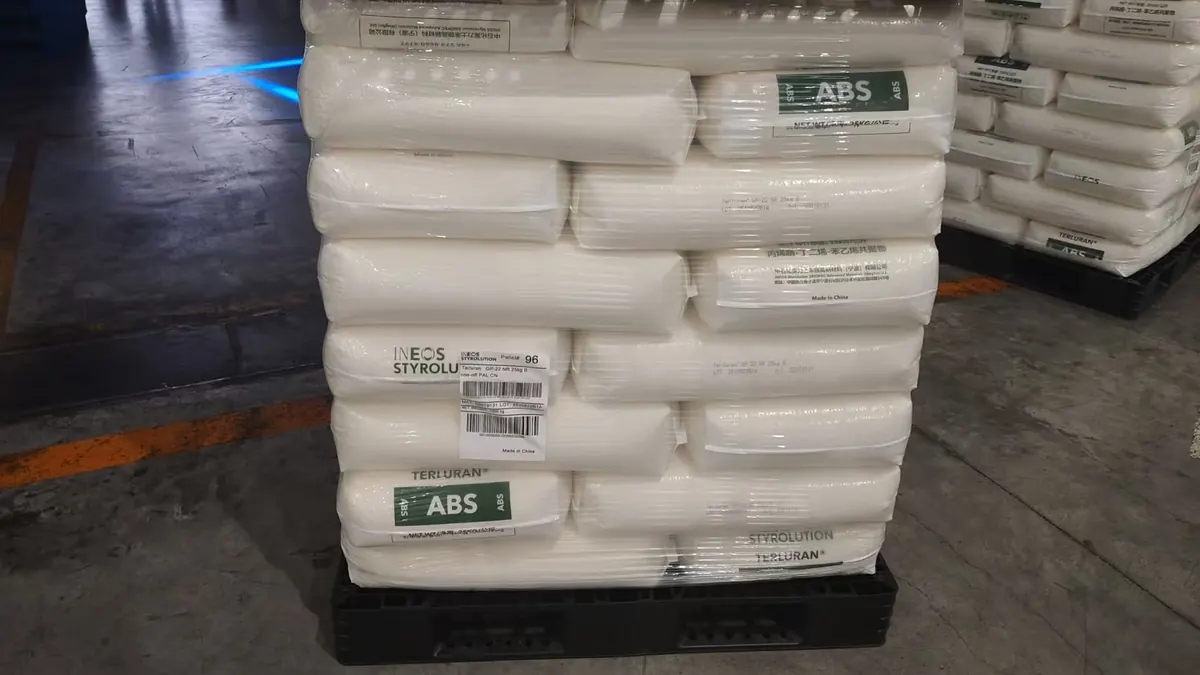
As of November 2026, ABS resin sells for roughly USD 1.6–2.2 per kg (USD 1,600–2,200 per ton), or about USD 0.73–1.00 per pound. China sits at the low end of that range and Europe at the high end. Behind those averages was one of the most volatile years for ABS in recent memory: a sharp rally in the spring, a slump through the summer that pushed producers into losses and run cuts, and a rebound into the fourth quarter.
If you are responsible for ABS supply, you probably felt every one of those swings. A quote that looked fair in February was out of date by April. Budgets set in the spring had to be redone by summer. And every time the market moved, the same questions came back: is this price reasonable, is now the right time to commit volume, and is there a lower-cost grade that will still run on our molds?
As an ABS supplier, we wrote this guide for procurement managers and engineers who source ABS resin in volume. It explains where the ABS price stands today in each major region, what moved it quarter by quarter in 2026, which cost drivers to watch, how grade and brand change your cost, how ABS compares with other plastics on real part cost, and what to expect in 2027. It ends with practical steps, including a landed-cost breakdown and a contract structure, to lower the delivered cost of ABS without adding quality risk.
Summary for procurement teams
- Price range. About USD 1.9/kg in Asia, USD 2.05/kg in North America and USD 2.2/kg in Europe (September 2026).
- A volatile year. A sharp spring rally, a summer slump with production cuts, then a rebound into the fourth quarter.
- Grade and brand matter. Flame-retardant and plating grades carry premiums; Chinese general-purpose grades usually price below imported brands with similar published properties.
- Compare delivered cost, not resin price. Trade terms, density and contract structure can change the real cost more than a month of market movement.
- 2027 outlook. Range-bound: ample capacity limits the upside, producer run cuts limit the downside.
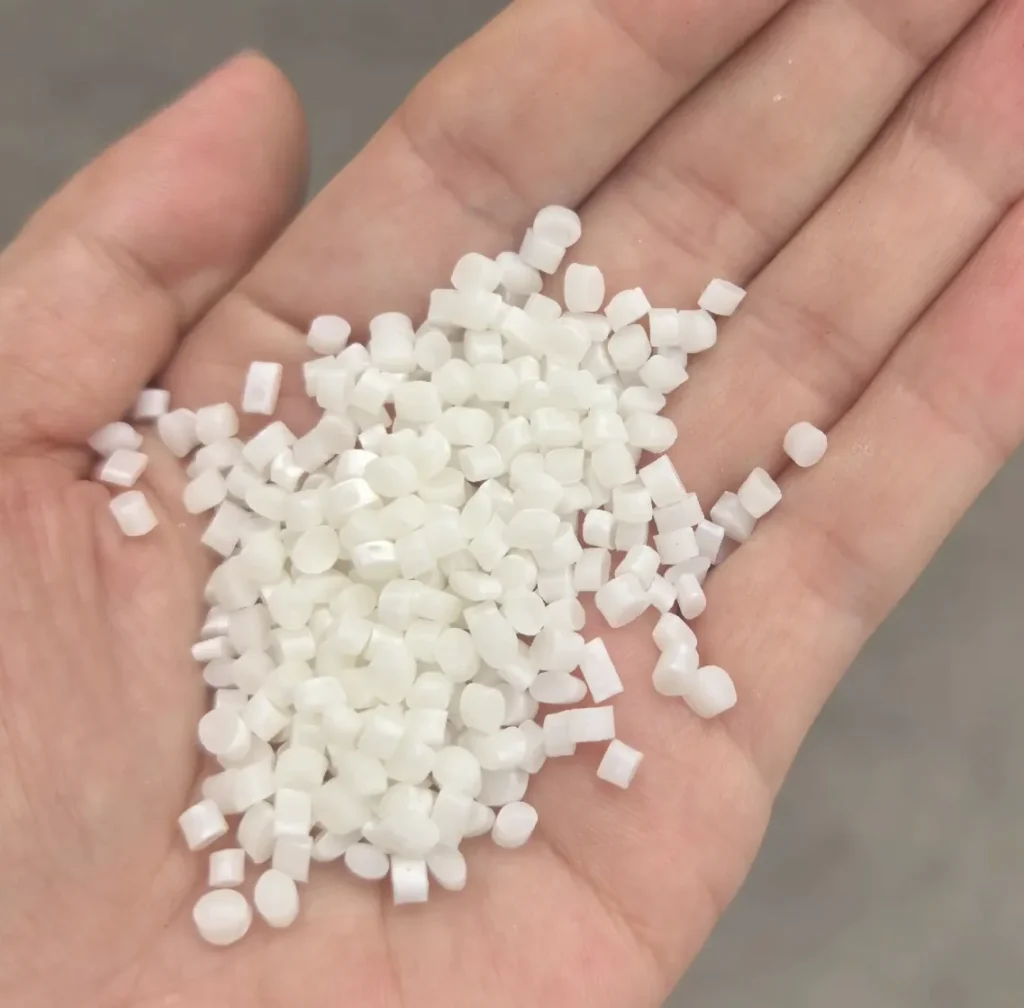
What Is the Current ABS Price in 2026?
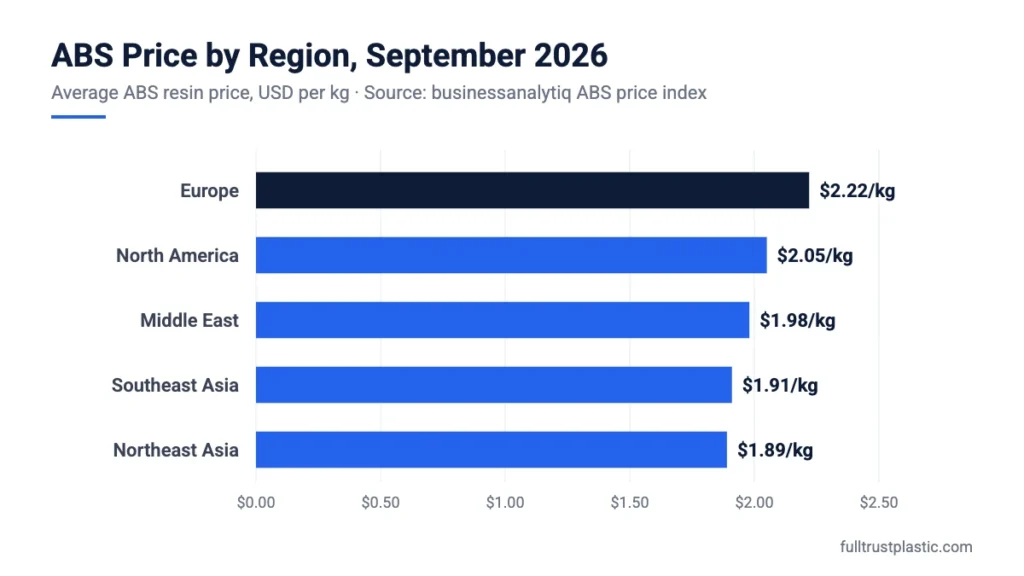
Whether you are setting next quarter’s budget, checking a supplier’s offer or explaining a cost increase to management, the first thing you need is a reliable reference point. The difficulty is that there is no single ABS price. The same general-purpose grade is priced differently in Shanghai, Ho Chi Minh City, Rotterdam and Houston, because each market has its own feedstock costs, plant utilization, freight economics and import duties. The table below gives the regional reference levels we use when we check our own offers, so you can see where a quote sits before you negotiate.
| Region | Price per kg (Sept 2026) | Price per ton | Market note |
|---|---|---|---|
| Europe | ~USD 2.22 | ~USD 2,220 | Highest regional level; Asian imports cap further increases |
| North America | ~USD 2.05 | ~USD 2,050 | Domestic supply, steady demand from auto and appliances |
| Middle East | ~USD 1.98 | ~USD 1,980 | Import-dependent; follows Asian offers plus freight |
| Southeast Asia | ~USD 1.91 | ~USD 1,910 | Main destination for Chinese, Korean and Taiwanese exports |
| Northeast Asia | ~USD 1.89 | ~USD 1,890 | Largest production hub; most competitive offers |
Inside China, general-purpose ABS was about RMB 12,080 per tonne in early November 2026, roughly USD 1.60/kg before 13% VAT. Export offers from China are usually quoted in US dollars on FOB or CFR terms and track this domestic level plus export costs.
Why Asia Is the Most Cost-Competitive Region
Northeast Asia is home to the world’s largest ABS producers in China, South Korea and Taiwan, and China has added a large amount of new capacity in recent years. That gives Asian producers scale, close access to styrene and butadiene, and a strong incentive to export when domestic demand is soft. Southeast Asia and the Middle East have little or no local production, so they price off Asian export offers plus freight. Europe and North America have their own producers, but higher energy and labor costs keep local prices above Asian levels, and imports flow in whenever the gap gets wide enough to cover freight and duties.
What a Quoted ABS Price Includes
Two quotes with the same headline price can mean very different costs. Before comparing supplier offers, check these points:
- Grade and color. Natural general-purpose grade is the baseline; black, pre-colored and specialty grades cost more.
- Trade terms. FOB, CFR/CIF and DDP prices include different shares of freight, insurance and duty.
- Packaging. 25 kg bags, jumbo bags and palletizing all carry different handling costs.
- Quantity and payment terms. Full-container orders and faster payment usually earn a better price than mixed loads or long credit.
- Price basis and validity. A spot offer may be valid for only a few days, while contract prices are often adjusted monthly or quarterly against a published index.
Those details can move the real price more than a week of market movement, so compare offers line by line.
ABS Price Trend in 2026: A Quarter-by-Quarter Review
If your ABS invoices looked very different from one month to the next this year, you were not alone. For many procurement teams, the hardest part of 2026 was not the price level itself but how quickly it changed, and how hard it was to tell a short spike from a lasting move. Looking back at each quarter makes the pattern clearer: the 2026 ABS price trend was shaped mainly by feedstock costs and producer run rates, not by strong demand. China’s benchmark, which leads most Asian export offers, shows the swings most clearly.
Q1 2026: Sharp Rebound from 2025 Lows
ABS entered 2026 near multi-year lows after a weak 2025, when oversupply and soft demand pushed prices down for most of the year. Converters had kept inventories thin, so when costs turned, many had to restock at the same time. In March, higher crude oil, freight disruption linked to the conflict involving Iran, and that restocking wave pushed China’s benchmark from about RMB 9,070 per tonne on 1 March to about RMB 12,670 on 1 April. Producers across Asia announced increases, and export offers into India and Southeast Asia followed quickly.
Q2 2026: Peak and Correction
The rally did not hold. Once restocking was done, appliance and electronics orders stayed soft, and feedstock costs eased as the initial energy shock faded. China’s benchmark fell about 9.5% in the first three weeks of April alone. Through May and June, high inventories at producers and traders, plus steady arrivals of import cargoes, kept Asian prices drifting lower into early summer. Converters that contracted volume at the late-March peak were left holding high-cost inventory.
Q3 2026: Production Cuts and Partial Recovery
Polymer resin producers responded to margin compression by reducing regional reactor run rates to 65% to 70%, creating supply tightening that supported a partial recovery from August into September, helped by firmer upstream costs.
By midsummer many ABS plants were selling below cost. Losses made the run cuts stick, and as inventories came down, sellers were able to push prices back up. Demand did not drive the recovery: downstream orders stayed weaker than the usual September peak season, and the rise came mainly from supply discipline and costs.
Q4 2026: Latest Movement
Prices strengthened into late October, when China’s benchmark reached about RMB 12,850 per tonne, then eased slightly in early November as converters resisted higher offers. The market now sits in its usual year-end pattern: converters reduce inventory to protect cash, producers balance run rates against slower orders, and both sides negotiate contract terms for 2027.
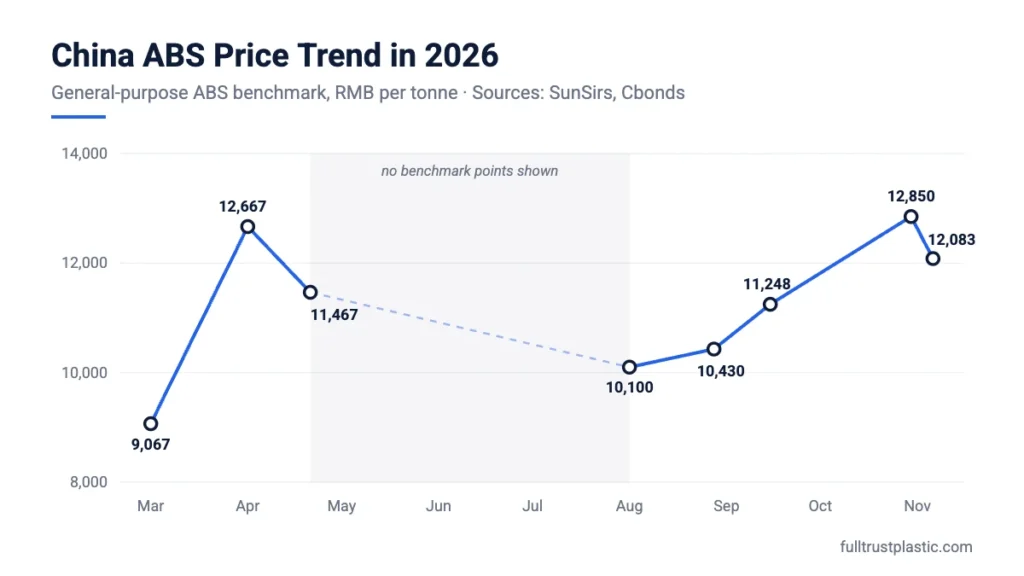
The lesson for procurement teams: ABS can move 10% or more within a few weeks. From the supplier side, we saw that teams which timed contract volumes around plant restarts and inventory cycles secured better terms than those forced to cover requirements at mid-quarter peaks.
What Drives ABS Prices?
When a supplier announces an increase, the natural question is whether it is justified or just an attempt to test the market. You can answer that much more confidently if you know what actually sits behind the ABS price. ABS is made from three petrochemical monomers, so its price follows those feedstocks first and demand second, with plant run rates, freight and currency deciding how much of each cost change reaches your invoice. Understanding each driver helps you judge whether a price move is likely to last, and gives you facts to bring to the negotiating table.
Styrene, Acrylonitrile and Butadiene
Styrene is the largest share of ABS by weight, which ties ABS closely to benzene and ethylene. Acrylonitrile follows propylene and ammonia, and butadiene follows the synthetic rubber and tire markets. When all three rise together, ABS producers raise prices quickly. When they move in different directions, ABS tends to drift with styrene. Watching weekly styrene prices is the simplest early warning for anyone sourcing ABS.
Crude Oil and Energy
Crude oil sets the floor for naphtha, the main cracker feedstock behind all three monomers. Energy costs also affect plant operating costs, especially in Europe. Sharp oil moves usually reach ABS prices within a few weeks.
Capacity, Run Rates and Turnarounds
New capacity in China has kept the market well supplied. When margins turn negative, producers cut run rates, and that is usually what stops a price slide. Planned maintenance turnarounds, which are often announced in advance, can tighten supply for a few weeks, so it pays to track the turnaround schedules of the major producers that supply your region.
Downstream Demand
Orders from automotive parts, home appliances, electronics and toys decide whether producers can pass cost increases on or have to absorb them. Strong demand lets producers hold price increases; weak demand forces them to give back gains, as happened in the second quarter of 2026.
Freight, Tariffs and Exchange Rates
Freight rates, import duties and tariffs decide the landed cost of imports, and local producers in import markets price against that landed cost. Exchange rates matter too: a stronger renminbi makes Chinese export offers more expensive in US dollar terms, while a weaker currency in an importing country raises local prices even when dollar prices stay flat.
Knowing these drivers helps in negotiation. When styrene or butadiene falls, purchasing managers have a clear, documented basis for renegotiating prices on forward deliveries.
ABS Price by Grade
Many procurement teams track one ABS price, but the resin they actually specify rarely matches that benchmark. Your parts may need a high-impact grade for a drop test, a flame-retardant grade for an electrical approval, or a plating grade for chrome trim, and each carries a different price. Grade choice is also one of the few cost levers you control directly: specifying a grade with more performance than the part needs is one of the most common reasons we see manufacturers paying more for ABS than they have to. The table shows how the main grade families compare and why.
| Grade | Price vs. general purpose | What drives the difference | Typical applications |
|---|---|---|---|
| General purpose | Baseline | Standard rubber content, basic stabilizers and mold release | Housings, enclosures, toys, household goods |
| High-impact | Moderate premium | Higher polybutadiene rubber content | Luggage, protective gear, structural parts |
| Plating grade | Premium | Tightly controlled rubber particle structure for plating adhesion | Chrome-plated auto trim, sanitary fittings |
| Flame-retardant | Highest premium of common grades | Flame-retardant additives plus UL testing and certification | Electrical enclosures, appliance and office equipment parts |
| Recycled ABS | Usually lower in Asia; can match virgin in Europe | Feedstock quality, sorting and certification of recycled content | Non-cosmetic and internal parts |
Halogen-free flame-retardant grades usually cost more than conventional ones, and plating grades are made by fewer qualified producers, which supports their premium. Natural grades carry the lowest price; custom colors and color matching add a further charge, especially for small lots.
Virgin ABS gives tight melt flow control and consistent color from lot to lot, which matters for visible parts. Recycled ABS is usually priced below virgin resin in Asia. In Europe, certified recycled ABS with traceable content can cost as much as virgin resin or more, because demand for recycled content is growing faster than supply.
Chinese General-Purpose Grades vs. Imported Brands
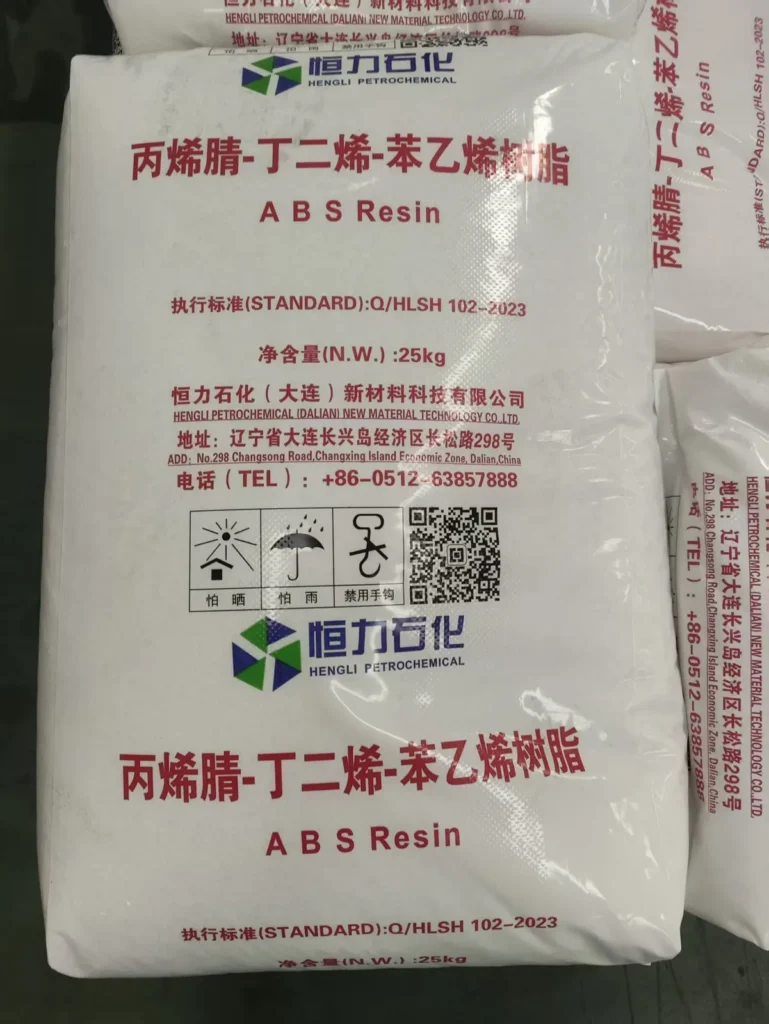
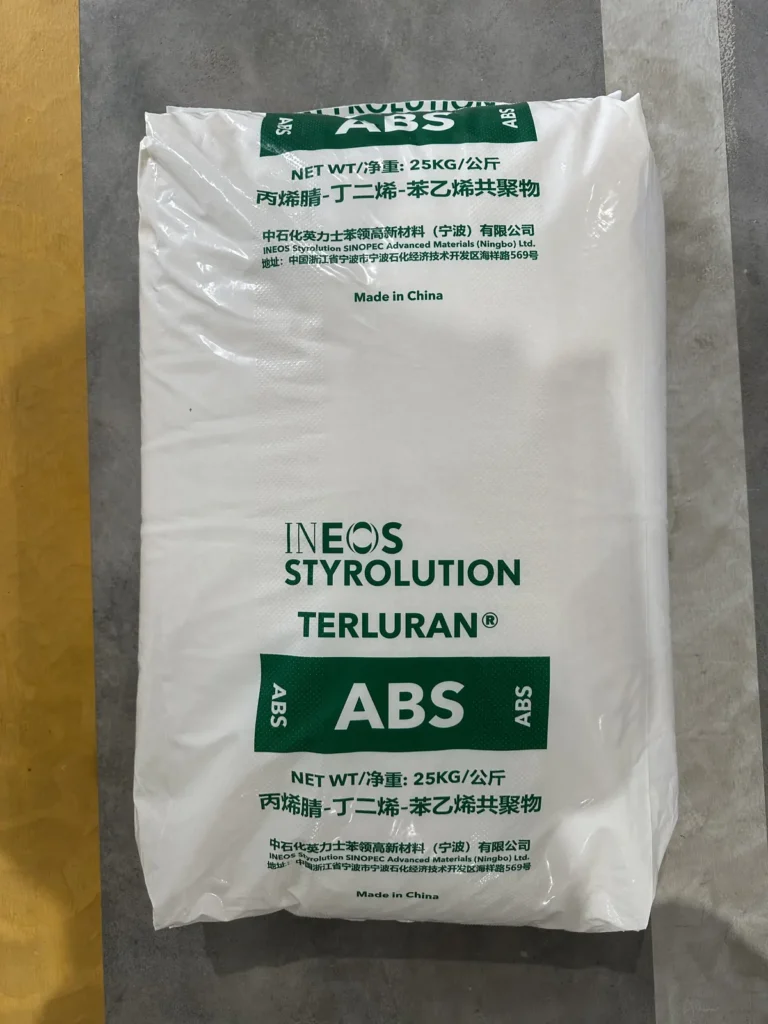
Brand is the other big price lever. Chinese general-purpose grades such as Hengli HA-714, PetroChina 0215A and ZPC ZA0211 usually price below imported brands such as LG Chem HI121H, Chimei PA-757 or INEOS Terluran GP-35. The question we hear most often is whether the lower price means lower performance. On the producers’ own data sheets, the gap is smaller than many expect:
| Grade | MFR, 220 °C/10 kg | Flexural modulus | Vicat | Producer positioning |
|---|---|---|---|---|
| Hengli HA-714 | 22 g/10 min | 2,306 MPa | 96 °C | Tight flow specification, EU REACH statement |
| PetroChina 0215A | 22 g/10 min | 2,300 MPa | 96 °C | Gloss and rigidity; FDA, RoHS and GB 4806.6 listed |
| ZPC ZA0211 | 20 g/10 min | 2,400 MPa | 95 °C | Certificate data for every lot |
| LG Chem HI121H | 22 g/10 min | ≈2,550 MPa | 95 °C | White goods; detailed processing data |
All four sit in the same flow class, so a switch rarely needs new process settings. The data sheets use different test standards (GB/T for the Chinese grades, ASTM for HI121H), so treat small differences as indicative and confirm on your own part. Where the imported brand still earns its premium is in specific approvals, color consistency for demanding white parts, or customer specifications that name the brand. For a full side-by-side, see our comparison of Chinese general-purpose ABS grades and our guide to Terluran GP-22 alternatives.
ABS Price vs. Other Plastics
When ABS prices rise, engineering and purchasing teams often ask whether a different material would cost less. Sometimes it would, but comparing price per kg alone can lead to the wrong answer. What you really pay for is the finished part, and that depends on how much resin goes into each part, how fast it molds, how many parts are rejected and how hard the material is on your tools. A material with a lower price per kg can end up costing more per part, and the reverse is also true. The table and example below show how to make that comparison properly.
| Material | Price vs. ABS | Density | Choose it when |
|---|---|---|---|
| ABS | — | 1.04–1.07 g/cm³ | You need gloss, paintability or plating, and good impact strength |
| PP | Lower | 0.90–0.91 g/cm³ | Cost and weight matter more than surface finish and rigidity |
| HIPS | Lower | 1.04–1.05 g/cm³ | Low-stress cosmetic housings and disposable parts |
| PC | Higher (about 20% in China, Nov 2026) | 1.20 g/cm³ | You need higher heat and impact resistance |
| PC/ABS | Between ABS and PC | 1.10–1.15 g/cm³ | ABS is not tough or heat-resistant enough, but PC is overkill |
Worked Example: Resin Cost per Part
Take a housing with a part volume of 100 cm³. Molded in ABS at a density of about 1.05 g/cm³, it uses about 105 g of resin. The same part in PP at about 0.905 g/cm³ uses about 90.5 g, roughly 14% less resin by weight. That means PP could cost up to about 16% more per kg than ABS and still give the same resin cost per part. The effect runs the other way for PC: at about 1.20 g/cm³ the part uses about 120 g, so PC’s higher price per kg turns into an even larger gap per part.
Resin weight is only the start. Cycle time, scrap rate, tool wear and secondary operations such as painting all belong in the comparison. PP may need a longer cooling time and painting or texturing to look like ABS, while glass-filled or flame-retardant compounds can wear tools faster. Ask your engineering team, or your supplier, for a part cost estimate rather than a resin price before you switch. For styrenic alternatives, see our GPPS vs HIPS guide.
ABS Price Forecast: Late 2026 and 2027 Outlook
Almost every procurement plan for 2027 starts with the same question: will ABS cost more or less next year? No one can predict the price exactly, and anyone who claims to should be treated with caution. What we can do is set out the forces that will shape the market, the scenarios that could push prices outside their recent range, and what that means for how you contract volume. Our overall ABS price forecast is a range-bound market: new capacity keeps supply ample, while demand from autos, appliances and electronics is steady but not strong.
In 2026 China’s benchmark has traded between about RMB 9,000 and 12,900 per tonne, and we expect 2027 prices to stay mostly inside a similar band unless crude oil or styrene make a major move. New styrene capacity in Asia should keep feedstock supply comfortable, which limits the upside from monomer costs. Butadiene remains the less predictable input, because it follows synthetic rubber demand from the tire industry. On the demand side, automotive programs give steady base volumes, while appliance and electronics makers are likely to keep purchasing cautiously.
- Could push prices up: higher crude oil or styrene, new freight disruption, unplanned plant outages, and deeper run cuts by loss-making producers.
- Could keep prices down: more new capacity in China, weak car and appliance output, and lower-priced Asian exports flowing into Europe and the Middle East.
- What procurement teams should do: watch styrene, butadiene, producer run rates and turnaround schedules; cover base volume with index-linked contracts and use spot cargoes for flexibility.
Timing matters as much as direction. ABS prices often firm after the Lunar New Year holiday, when converters restock, and soften in the weeks before major holidays and at year-end, when converters cut inventory. Manufacturers that hold one or two months of safety stock have more freedom to avoid contracting at short-term peaks.
How to Secure a Competitive ABS Price: Procurement Tips for 2026
A lower price per kg is the most visible saving, but it is rarely the largest one. In our experience, the manufacturers who pay the least for ABS over a year are not the ones who push hardest on every quote. They are the ones who specify the right grade, compare offers on a delivered basis, agree clear pricing formulas with their suppliers and plan volumes ahead of the market. The lowest quote is not always the lowest total cost. These steps lower the delivered cost of ABS without adding quality risk.
- Compare equivalent specifications. Match grades on melt flow rate, Izod impact and heat deflection temperature instead of brand name, so qualified generic grades can compete with branded ones.
- Ask for full documentation. Get the TDS, a COA for every lot, and RoHS or REACH declarations. Our guide on how to read an ABS technical data sheet shows what to check.
- Confirm virgin vs. recycled content. Make sure the quote states whether the resin is pure virgin or contains regrind.
- Consolidate volumes. Combine orders across plants or programs to reach full-container quantities and volume pricing.
- Use index-linked contracts. Link contract prices to published monomer or ABS benchmarks instead of fixed prices that need renegotiation every time the market moves.
- Compare landed cost. Compare FOB, CIF and DDP offers on a like-for-like basis, including duties, port charges and inland freight.
- Time contract volumes around the market. Watch styrene and producer announcements, and avoid committing large volumes right after a sharp spike unless supply is at risk.
- Qualify more than one source. Having two approved grades, such as one Chinese and one imported, gives you leverage in negotiations and protects supply during plant outages.
Landed Cost: What Changes from FOB to DDP
Offers on different trade terms cannot be compared directly. A low FOB price can turn into a higher delivered cost than a DDP offer once freight, insurance, duty and destination charges are added. The table shows which costs are included in the supplier’s price under each common term, and which ones you pay separately.
| Cost element | FOB | CFR | CIF | DDP |
|---|---|---|---|---|
| Resin, packaging and palletizing | Included | Included | Included | Included |
| Export clearance and loading at origin port | Included | Included | Included | Included |
| Ocean freight | You pay | Included | Included | Included |
| Cargo insurance | You pay | You pay | Included | Included |
| Destination port charges and import clearance | You pay | You pay | You pay | Included |
| Import duty and taxes | You pay | You pay | You pay | Included |
| Inland delivery to your plant | You pay | You pay | You pay | Included |
To compare offers fairly, convert each one to a delivered cost per kg at your plant. Duties also depend on the origin of the resin and any trade agreements, so the same grade can have a different landed cost depending on where it is made.
Our payment terms. Trade terms decide who pays for freight and duty; payment terms decide when and how the cargo is paid for, and both affect the price we can offer. For a first order, we work on T/T or an irrevocable L/C at sight. These are the standard terms for new trading relationships in the resin market, and they let us quote our most competitive price without building credit risk into it. Once we have completed several shipments together and built a track record, we are open to discussing other payment terms that fit your cash flow.
Structuring an Index-Linked ABS Contract
For regular volumes, an index-linked contract gives both sides a fair price without renegotiating every month. A clear contract usually defines:
- Base price. The agreed price at the start of the contract, on a defined trade term and grade.
- Reference index. A published ABS or styrene benchmark that both sides can check, such as a China domestic ABS price or a regional ABS assessment.
- Adjustment period. Monthly or quarterly, usually based on the average of the index over the previous period rather than a single day.
- Pass-through share. How much of each index move is passed into the price, which can be all of it or an agreed portion.
- Cap and floor. Optional limits on how far the price can move in one period, which protect both sides from extreme swings.
- Volume commitment. The planned monthly or quarterly volume, with an agreed tolerance for changes in your production plan.
A slightly lower-priced resin that causes more shrinkage, longer cycles or late deliveries ends up costing more per finished part. Evaluating the total cost of ownership protects your margins from hidden logistical and operational costs.
Why Source ABS Pellets from Fulltrust
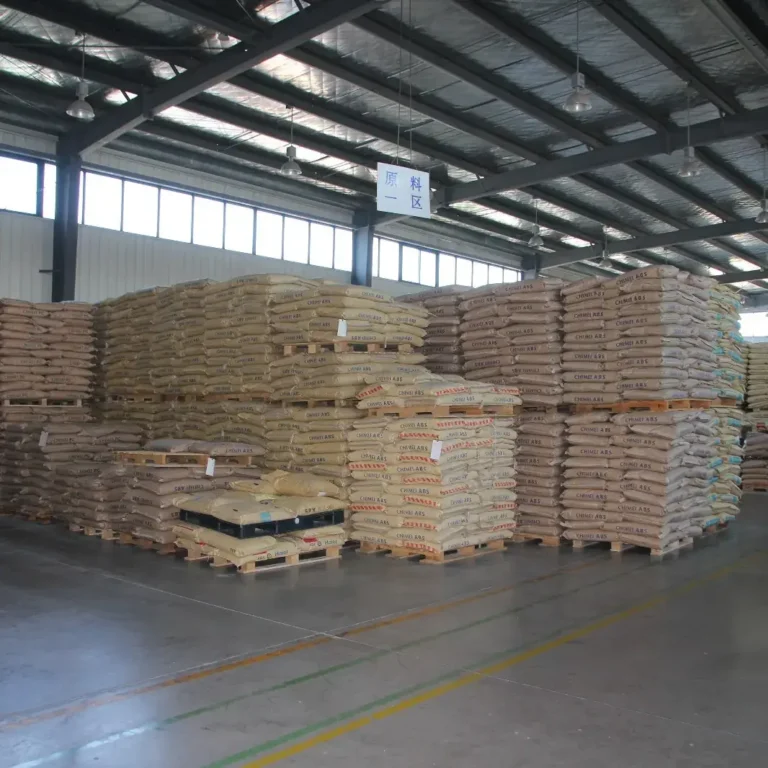
Choosing an ABS supplier is not only about the price on the first order. It is about whether every lot runs the same on your machines, whether documents arrive before the cargo, whether someone can tell you honestly that a lower-cost grade will work for your part, and whether supply holds when the market tightens. Those are the things that cost you money when they go wrong, and they are what we focus on as a supplier.
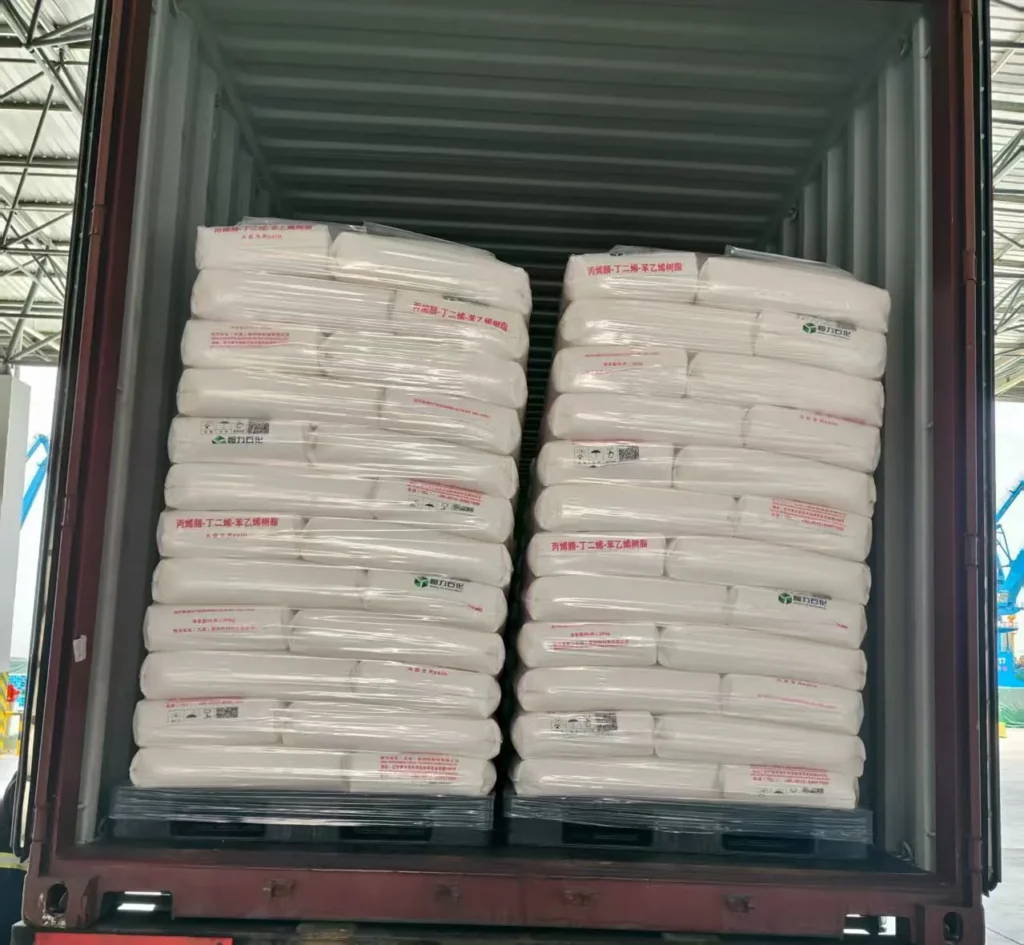
Fulltrust is an ABS supplier serving manufacturers and converters worldwide. We supply both branded and Chinese grades, so our customers can choose on performance and cost. Our range includes general-purpose grades such as Hengli HA-714 and ZPC ZA0211, LG Chem grades such as HI121H, Chimei grades such as PA-757, and INEOS Terluran, together with high-impact, flame-retardant and custom color-matched grades on request.
Every shipment comes with a COA, and we provide TDS and compliance declarations before you order, with lot-by-lot documentation you can file for traceability. If you are paying for a branded grade, we can cross-reference it to a qualified lower-cost equivalent and arrange samples for trial molding before you switch.
We also handle export logistics, from palletizing and container loading to documents, and quote transparently on the trade term you need, so your quote reflects the real delivered cost rather than just the resin price. For customers with regular demand, we plan shipments against your production schedule, which reduces the risk of contracting at short-term price peaks.
Related reading
- Chinese general-purpose ABS compared: Hengli HA-714, Yulong A-2020, PetroChina 0215A and ZPC ZA0211
- Terluran GP-22 alternatives: how CHIMEI PA-757 and PetroChina 0215A compare
- CHIMEI PA-757 vs PA-757K vs PA-757H: what the codes mean and how to order
- LG Chem HI121H ABS for white goods: drying, molding conditions and regrind
- How to read an ABS technical data sheet
- ABS drying and molding conditions by grade
- All grades: ABS resin, HIPS resin, PP resin
Frequently asked questions
What is the ABS price today per kg, per ton and per pound?
Why is my ABS quote higher than the published benchmark price?
Are Chinese ABS prices quoted with or without VAT?
How long is an ABS price quote valid?
What payment terms does Fulltrust accept?
How far in advance should I order ABS?
What documents come with an ABS export shipment?
How should ABS be stored after delivery?
Conclusion: Planning ABS Procurement for 2027
ABS price 2026 has been defined by volatility within a market that has plenty of capacity. Prices rose sharply in the spring, fell back through the summer, recovered on producer run cuts and ended the year near the top of their range. For most of 2027 we expect the same forces to keep prices inside a similar band, with crude oil, styrene and producer discipline deciding where in that band the market sits.
For procurement teams, the best results will come from matching the grade to the job, comparing landed costs rather than resin prices, structuring contracts that follow a clear index, and timing contract volumes around feedstock moves. If you would like a second view on your current grade or your next contract, our team is ready to help.