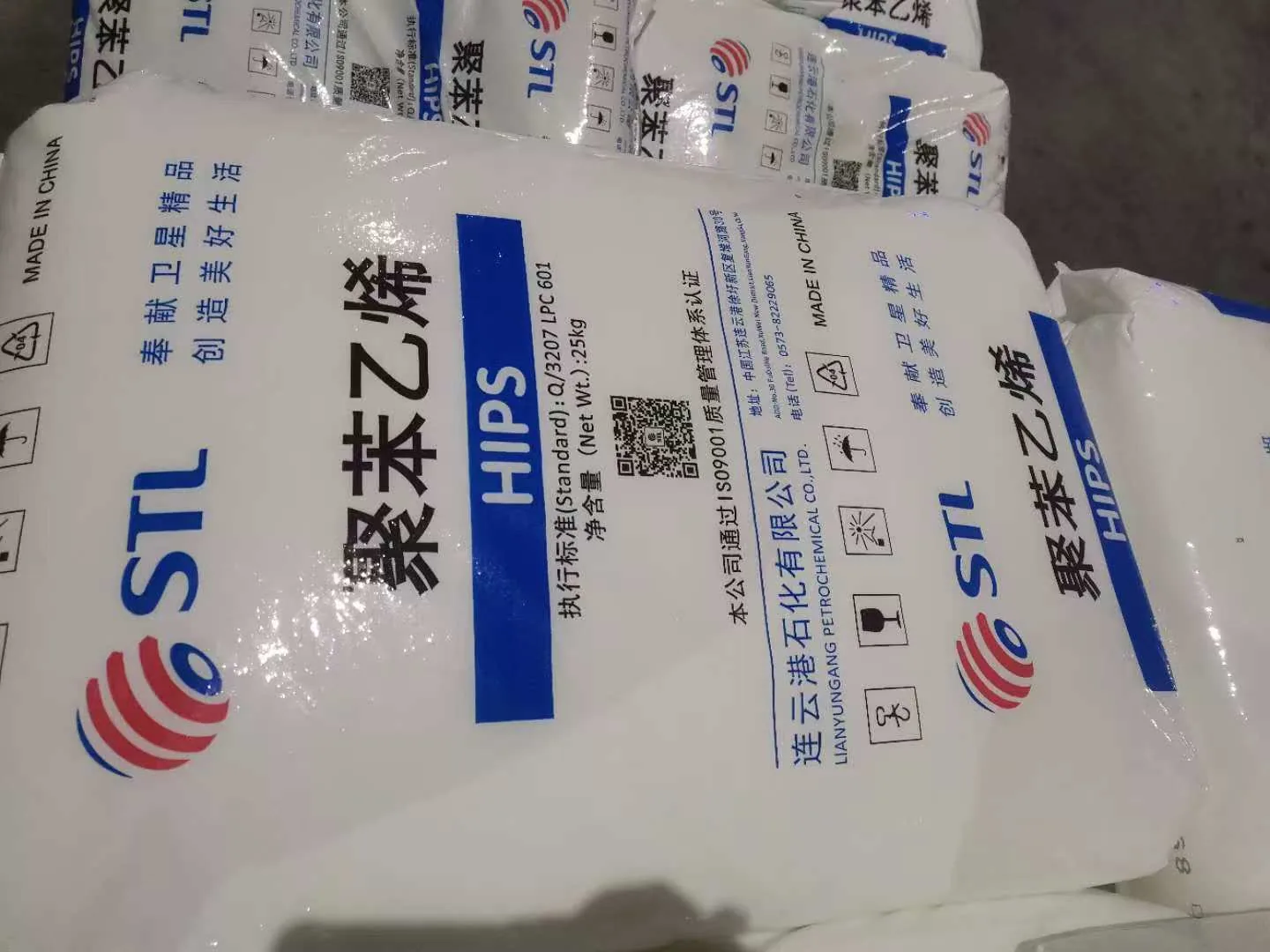
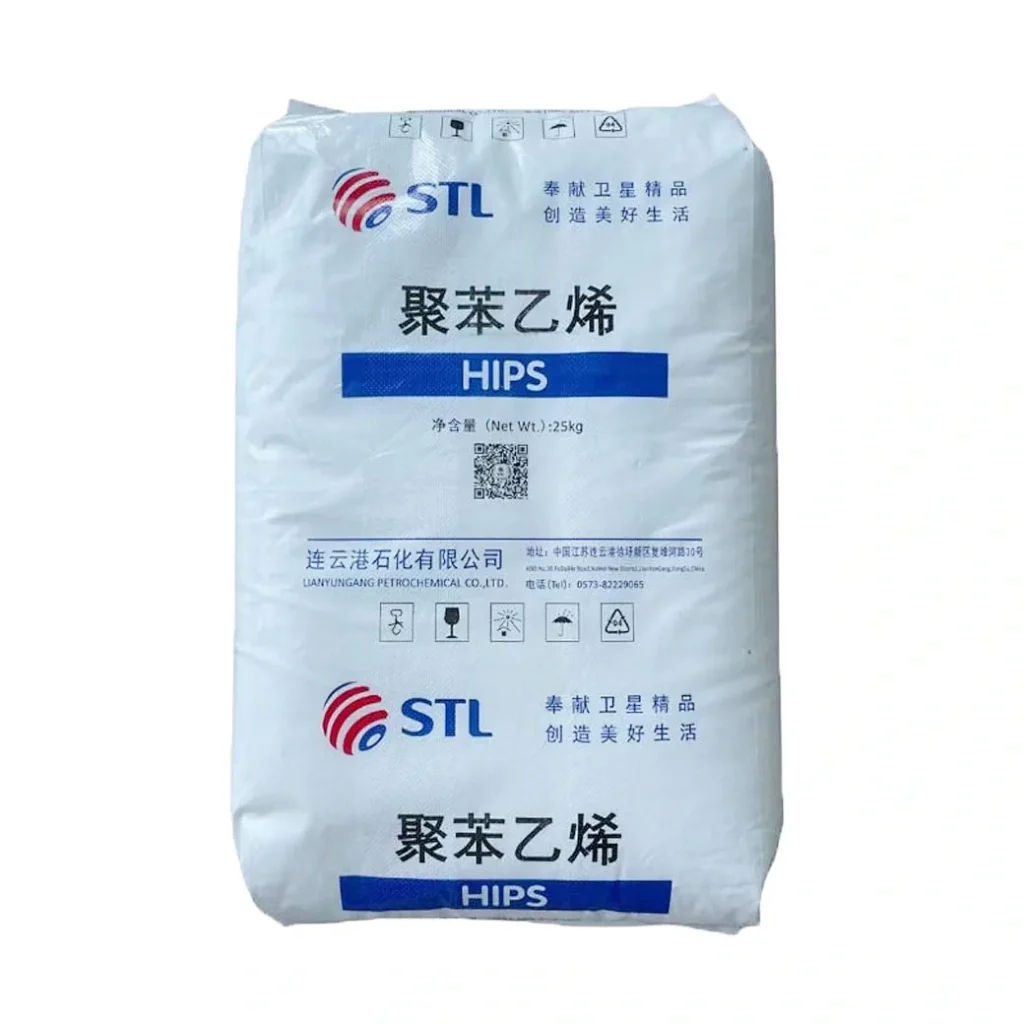
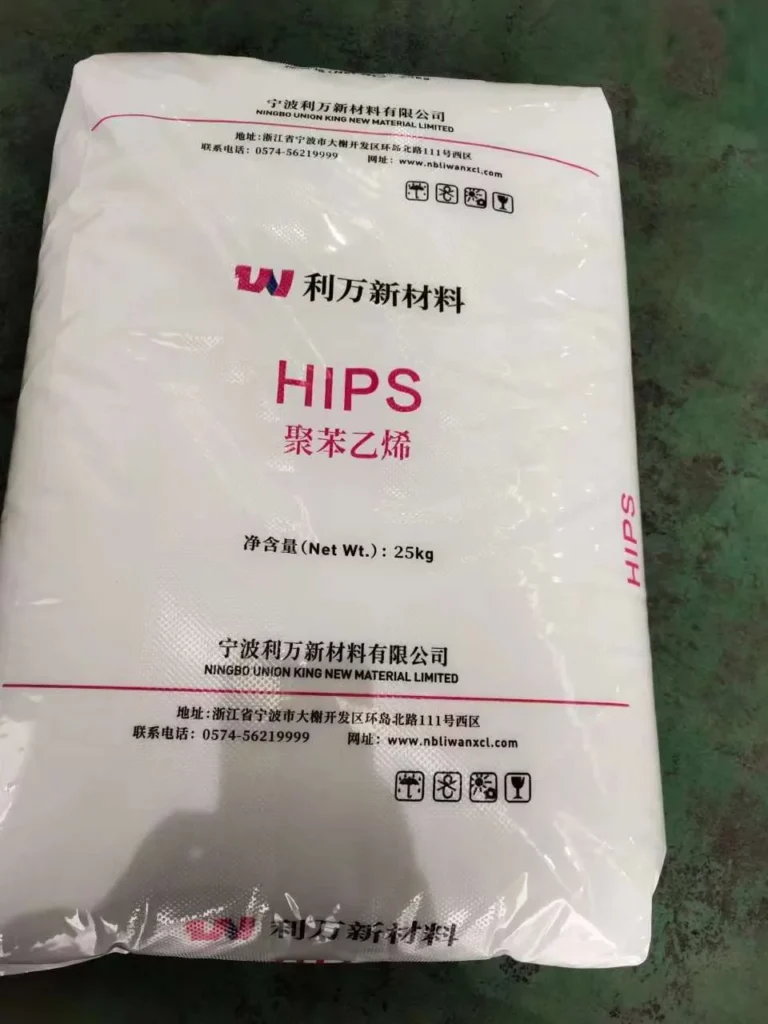
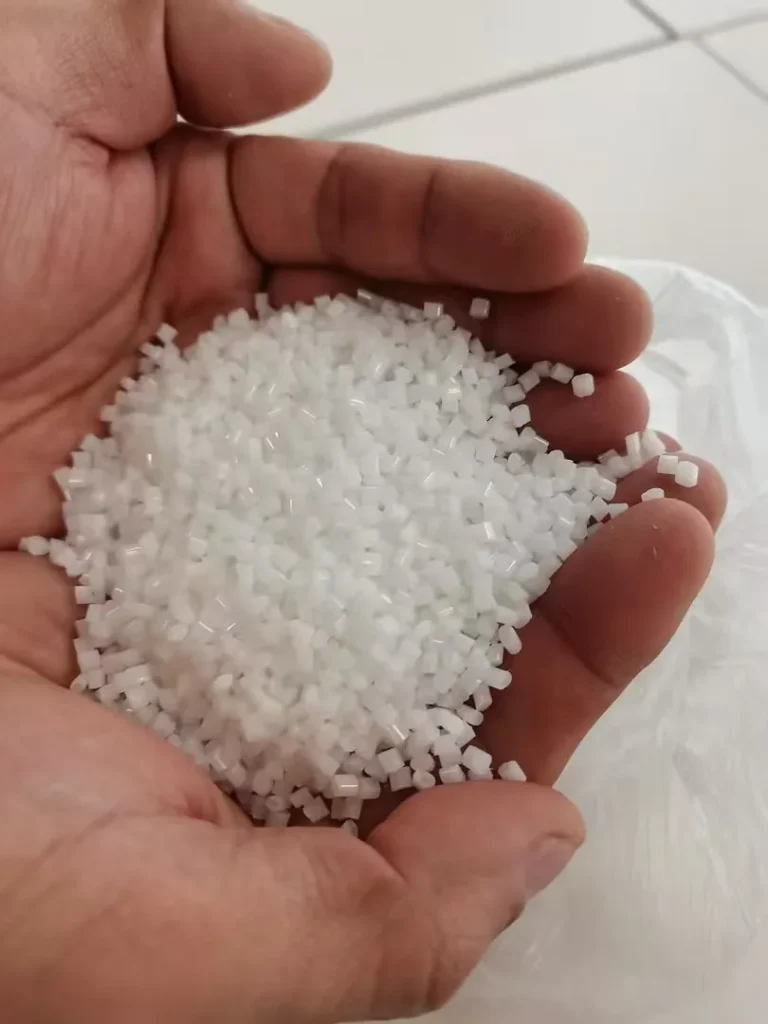
High-impact polystyrene (HIPS) is polystyrene toughened with a rubber phase. It gives up the clarity of GPPS in exchange for impact strength, and is used for appliance and electronics parts, refrigerator liners, trays, toys and stationery. This guide compares three HIPS grades we supply: STL 88 and STL 888GH from Lianyungang Petrochemical, and Liwan HP 825 from Ningbo Union King New Material.
Summary for purchasing and engineering teams
- Same flow range. Melt flow is 3.7–4.7 g/10 min across the three grades, so a change rarely needs new process settings.
- STL 88: toughness. Notched Izod 11.5 kJ/m² and 50% elongation, with Vicat of 93 °C and HDT of at least 85 °C.
- STL 888GH: gloss. Specified for a 60° gloss of at least 90, with impact of at least 10 kJ/m² and a natural-color (Z−Y) limit.
- Liwan HP 825: stiffness with certificate data. Flexural modulus of at least 1,900 MPa (lot 2,180) and impact of at least 8.0 kJ/m² (lot 10.6), documented lot by lot.
Published values side by side
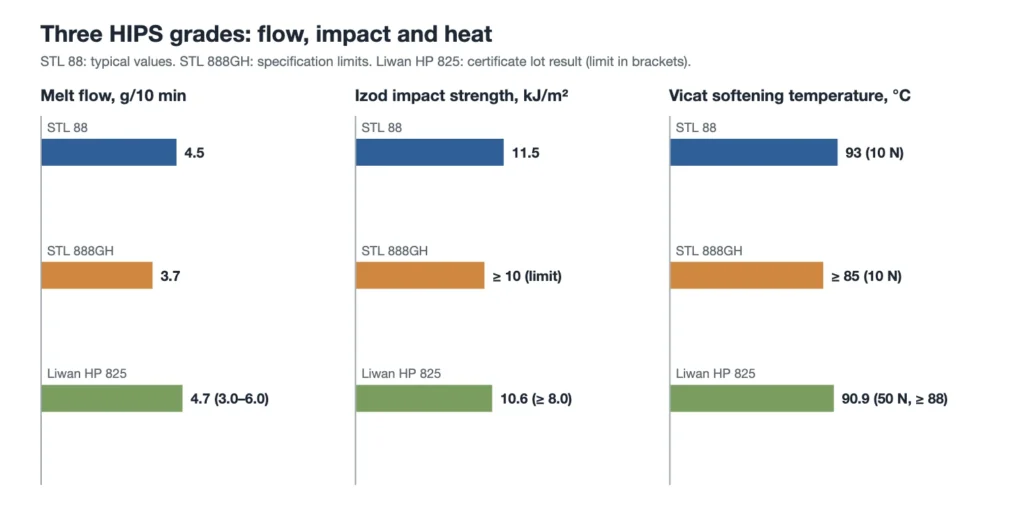
STL 88 values are typical values; STL 888GH values marked ≥ or ≤ are specification limits; Liwan HP 825 shows the specification limit with the certificate lot result in brackets. Where a property is not given, the cell shows “/”.
| Property | STL 88 | STL 888GH | Liwan HP 825 |
|---|---|---|---|
| Basis | Typical | Specification limits | Specification (lot) |
| Melt flow, g/10 min | 4.5 (200 °C/5 kg) | 3.7 (200 °C/5 kg) | 3.0–6.0 (4.7) |
| Izod impact, kJ/m² | 11.5 (notched, 4 mm) | ≥ 10 (A-notch) | ≥ 8.0 (10.6) |
| Tensile strength, MPa | 31 (at break) | ≥ 20 (at yield) | ≥ 23.0 (27.9) |
| Modulus, MPa | Tensile 2,200 | Flexural: report | Flexural ≥ 1,900 (2,180) |
| Flexural strength, MPa | / | / | ≥ 42.0 (46.2) |
| Elongation at break | 50% | / | / |
| Vicat, °C | 93 (10 N) | ≥ 85 (10 N) | ≥ 88 (90.9), 50 N |
| HDT, 1.8 MPa, °C | ≥ 85 | / | / |
| Gloss, 60° | / | ≥ 90 | / |
| (Z−Y) chromaticity | / | ≤ 19 | / |
| Residual styrene | < 500 ppm | ≤ 500 mg/kg | ≤ 700 ppm (302) |
| UL 94 | HB | / | / |
Vicat at 10 N reads higher than at 50 N.
Where the grades differ
- Toughness: STL 88. 11.5 kJ/m² notched Izod and 50% elongation make it the safest choice for parts that are dropped, flexed or snapped together.
- Surface: STL 888GH. The 60° gloss requirement of at least 90 suits visible appliance and electronics parts that are not painted. The (Z−Y) chromaticity limit of 19 helps with white and light shades.
- Stiffness: Liwan HP 825. Flexural modulus of 2,180 MPa and flexural strength of 46.2 MPa on the example lot, with every property certified per lot.
- Heat is similar. STL 88 lists Vicat 93 °C at 10 N; Liwan HP 825 90.9 °C at 50 N, which would read higher at 10 N. For parts near heat sources, test the part.
Which grade for which part
| Part | Grade to evaluate first | Why |
|---|---|---|
| Parts that are dropped or snap-fitted | STL 88 | Highest published Izod and 50% elongation |
| Visible glossy housings and panels | STL 888GH | 60° gloss specified at ≥ 90 |
| Trays, liners and stiff internal parts | Liwan HP 825 | Flexural modulus ≥ 1,900 MPa, certified per lot |
| White or light-colored parts | STL 888GH | Natural color limited by (Z−Y) ≤ 19 |
| Blending into GPPS for toughness | Any of the three, after trial | Flow of 3.7–4.7 g/10 min matches 535-class GPPS |
Switching between HIPS grades
- Check the property the part depends on: impact, gloss or stiffness.
- Compare on one basis: note typical values against limits and the Vicat load.
- Trial on the production tool with the current settings; flow is similar across the three grades.
- Check color and gloss against the master sample for visible parts.
- Approve the lot range and match each certificate at goods-in.
Related grades and reading
Frequently asked questions
Which HIPS grade has the highest impact?
What is STL 888GH used for?
Are STL 88 and Liwan HP 825 interchangeable?
Is HIPS transparent?
Are these grades flame rated?
What residual styrene do they have?
Can HIPS be blended with GPPS?
How are these grades packed?
STL 88, STL 888GH and Liwan HP 825 share a flow range but differ in what they are built for: toughness, gloss or stiffness. Choosing by the property the part depends on, then confirming on the part, keeps HIPS selection simple.