An ABS technical data sheet looks like a simple list of numbers, but the same property can be reported in three test systems, in four sets of units and under different conditions. Put two data sheets side by side without reading the small print and a grade can look 15 °C more heat resistant, or twice as stiff, than it really is.
This guide explains how to read an ABS TDS the way an engineer or purchasing team needs to: which numbers can be compared directly, which cannot, and how to convert the units that most often cause mistakes. The examples come from the data sheets of grades we supply, including INEOS Terluran GP-22, GP-35, HI-10, CHIMEI PA-757, LG Chem HI121H and Chinese grades such as PetroChina 0215A and Hengli HA-714.
Summary for purchasing and engineering teams
- Check the test system first. ISO, ASTM and GB/T methods use different specimens and conditions. Compare grades within one system, or treat differences of a few units as noise.
- MFR is not MVR. Mass flow (g/10 min) and volume flow (cm³/10 min) at the same 220 °C/10 kg are different figures.
- Read the condition column. Vicat at 10 N reads about 4–13 °C higher than at 50 N on our examples; annealed HDT reads 15–22 °C higher than unannealed.
- Typical values are not limits. A typical value describes average production. A specification limit is what every lot must meet. Incoming inspection works against limits and COAs.
1. Which test system is the sheet using?
Every ABS producer documents its grades under one main system. The system decides the specimen shape, conditioning and often the unit.
| System | Typical producers and examples | Typical units |
|---|---|---|
| ISO | INEOS Styrolution (GP-22, HI-10), CHI MEI (PA-757) | MPa, kJ/m², cm³/10 min, °C |
| ASTM | INEOS Americas sheet for GP-35, LG Chem HI121H, Yulong A-2020 | psi or kg/cm², ft-lb/in, J/m or kg·cm/cm, °F or °C |
| GB/T (Chinese national standards) | PetroChina 0215A, Hengli HA-714, ZPC ZA0211 | MPa, kJ/m², g/10 min, °C |
GB/T methods are largely based on ISO, so GB/T and ISO values are close in meaning, but specimen preparation and conditioning can still differ. ASTM values are not directly comparable with either. As a rule, do not approve or reject a grade on a difference of a few MPa or a few degrees between two different systems.
2. Melt flow: MFR, MVR and the test condition
- MFR (melt mass-flow rate) is the mass of melt extruded in 10 minutes, in g/10 min. PetroChina, Hengli, Yulong, ZPC and LG Chem report MFR.
- MVR (melt volume-flow rate) is the volume, in cm³/10 min (CHI MEI writes ml/10 min, the same unit). INEOS reports MVR for GP-22 (19) and HI-10 (5.5), and CHI MEI for PA-757 (18).
- The condition matters. For ABS the usual condition is 220 °C/10 kg, but sheets also show others. The GP-35 sheet gives three figures for the same grade: 3.1 g/10 min at 200 °C/5 kg, 34 g/10 min at 220 °C/10 kg and MVR 11 cm³/10 min at 230 °C/3.8 kg.
MFR and MVR are linked through melt density, so they are close but not the same number. When you set an incoming flow range, set it in the unit and condition that appear on the supplier’s COA.
3. Strength and stiffness: units and conversions
Tensile and flexural values on ASTM sheets are often in psi or kg/cm². Converting them to MPa makes the sheet readable next to ISO and GB/T values, but the test method still differs.
| From | To | Multiply by | Example from our grades |
|---|---|---|---|
| psi | MPa | 0.006895 | GP-35 tensile stress at yield 6,520 psi ≈ 45 MPa |
| 10³ psi (kpsi) | MPa | 6.895 | GP-35 flexural modulus 341 kpsi ≈ 2,351 MPa |
| kg/cm² | MPa | 0.0981 | HI121H tensile strength 500 kg/cm² ≈ 49 MPa |
| GPa | MPa | 1,000 | PA-757 flexural modulus 2.2 GPa = 2,200 MPa |
Also check which tensile value is shown. “Tensile stress at yield” and “tensile strength at break” differ: PA-757 lists 47 MPa at yield and 34 MPa at break.
4. Impact: Izod, Charpy and why units cannot be converted
Impact is the property most often misread. Producers use two different tests and two families of units.
| Reported as | Test | Example |
|---|---|---|
| kJ/m², notched Izod | ISO 180 or GB/T 1843 | GP-22 26 kJ/m², HA-714 21 kJ/m² |
| kJ/m², notched Charpy | ISO 179 or GB/T 1043 | GP-22 22 kJ/m², PA-757 21 kJ/m², 0215A 22 kJ/m² |
| J/m, ft-lb/in or kg·cm/cm, notched Izod | ASTM D256 | GP-35 4.5 ft-lb/in (≈ 240 J/m), HI121H 23 kg·cm/cm (≈ 226 J/m) |
- Izod and Charpy are not the same test. The same grade gives different values: GP-22 lists 26 kJ/m² Izod and 22 kJ/m² Charpy.
- J/m and kJ/m² cannot be converted. ASTM divides the energy by specimen thickness (J/m); ISO divides it by the cross-section area (kJ/m²). Within the ASTM family, 1 ft-lb/in ≈ 53.4 J/m and 1 kg·cm/cm ≈ 9.81 J/m.
- Check the specimen thickness and temperature. ASTM sheets give 1/8″ (3.2 mm) or 1/4″ (6.4 mm) specimens; thinner specimens usually read higher. Cold-impact rows (−30 °C) matter for outdoor and cold-storage parts: HI-10 keeps 14 kJ/m² Izod at −30 °C, PA-757 lists 9.
5. Heat resistance: Vicat load and HDT annealing
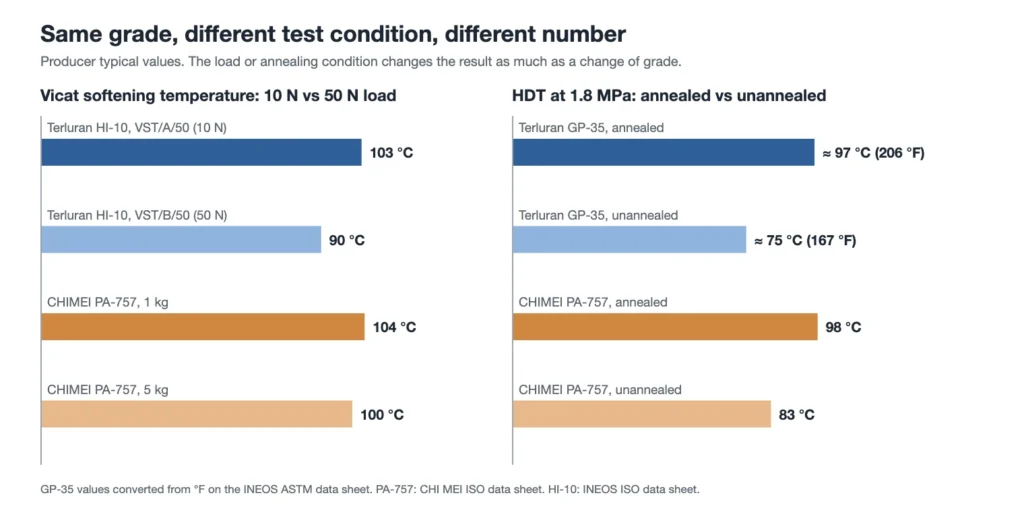
- Vicat A or B. ISO 306 runs Vicat under 10 N (method A) or 50 N (method B). Older sheets write 1 kg (≈ 10 N) and 5 kg (≈ 50 N). HI-10 lists 103 °C at 10 N and 90 °C at 50 N; PA-757 104 °C at 1 kg and 100 °C at 5 kg. Always compare the same load.
- HDT annealed or unannealed. Annealing relieves molded-in stress and raises HDT. GP-35 lists about 75 °C unannealed and 97 °C annealed at 1.8 MPa (167 °F and 206 °F), PA-757 83 °C and 98 °C. Unannealed values are closer to a molded part in service.
- HDT load. 1.8 MPa equals 264 psi or 18.6 kg/cm²; 0.45 MPa equals 66 psi. HDT at 0.45 MPa reads higher.
6. Typical values, specification limits and COA results
| Type of value | What it means | Example |
|---|---|---|
| Typical value | Average of production, for design and comparison; not guaranteed | 0215A Charpy 22 kJ/m² |
| Specification limit | What every conforming lot must meet | HA-714 MFR 20.0–23.0 g/10 min, Izod ≥ 14 kJ/m² |
| COA or certificate result | Measured value for one lot | ZA0211 lot: MFR 20.3 g/10 min, Charpy 23 kJ/m² |
Design and grade comparison use typical values. Incoming inspection compares each COA with the specification limits, or with the range agreed during qualification.
7. Color, flammability and the rest of the sheet
- Yellowness and whiteness depend on the standard. GP-22 lists yellowness index 13 under DIN 6167, 0215A lists 20 under HG/T 3862, A-2020 lists whiteness 40% under ASTM E313. Use them to rank grades from one producer, and confirm color with a trial against your master sample.
- UL 94 is grade-, color- and thickness-specific. PA-757 and HI121H list HB at 1.5 mm. A data-sheet rating is not a UL listing for your part.
- Density. ISO sheets may write kg/m³ (HI-10: 1,030 kg/m³) and others g/cm³ (1.03). Specific gravity is the same figure without a unit.
- Processing rows such as drying, melt and mold temperature are starting points. HI121H, for example, lists drying at 75–85 °C for 2–4 hours to below 0.1% moisture and at most 15% regrind.
A five-step checklist for any ABS TDS
- Identify the system. ISO, ASTM or GB/T, and the issue date of the sheet.
- Read the condition column. Flow condition, Vicat load, HDT load and annealing, specimen thickness and test temperature.
- Normalize units. Convert psi and kg/cm² to MPa and °F to °C, but do not convert J/m to kJ/m².
- Separate typical values from limits. Use typical values for comparison, limits and COAs for acceptance.
- Confirm on the part. Where values come from different systems, a molding trial and part test decide.
Data sheets of our main ABS grades
| Grade | System | Flow as published |
|---|---|---|
| INEOS Terluran GP-22 | ISO | MVR 19 cm³/10 min (220 °C/10 kg) |
| INEOS Terluran GP-35 | ASTM | MFR 34 g/10 min (220 °C/10 kg) |
| INEOS Terluran HI-10 | ISO | MVR 5.5 cm³/10 min (220 °C/10 kg) |
| CHIMEI PA-757K | ISO | MVR 18 cm³/10 min (220 °C/10 kg) |
| LG Chem HI121H | ASTM | MFR 22 g/10 min (220 °C/10 kg) |
| PetroChina 0215A | GB/T | MFR 22 g/10 min (220 °C/10 kg) |
| Hengli HA-714 | GB/T | MFR 20.0–23.0 g/10 min, specification |
| Yulong A-2020 | ASTM | MFR 20 g/10 min (220 °C/10 kg) |
For a side-by-side reading of Chinese grades, see our comparison of HA-714, A-2020, 0215A and ZA0211. All grades are listed under ABS resin.
Frequently asked questions
Can I compare an ISO data sheet with an ASTM data sheet?
What is the difference between MFR and MVR?
How do I convert Izod impact from J/m to kJ/m²?
Why does the same grade show two Vicat values?
Should I use annealed or unannealed HDT?
Are typical values guaranteed?
Why do yellowness values differ so much between producers?
Which document should I check at goods-in?
An ABS data sheet is reliable when it is read with its test system, units and conditions. Comparing grades within one system, converting only what can be converted and approving against limits and COAs rather than typical values keeps grade selection and incoming inspection free of surprises.