General-purpose ABS has a tensile yield strength of about 40–50 MPa (5,800–7,250 psi) and a modulus of elasticity of about 2.0–2.6 GPa. It is moderately strong and stiff, and much tougher than most plastics in its price range.
When engineers look up the tensile strength of ABS plastic, the real question is usually practical: will this housing, bracket or clip hold its load, is ABS strong enough compared with PLA, PP or PC, which number should go into the calculation, and which grade should be specified? A single datasheet figure answers only part of that. You also need to know the difference between yield and break, how temperature and molding affect strength, and how much margin to leave.
As an ABS supplier, we help molders and design teams answer these questions when they qualify a grade or consider a lower-cost alternative. This guide gives typical ABS tensile strength, yield strength and modulus values, explains what each means, compares ABS with other plastics, covers what reduces strength in real parts, and finishes with grade differences and practical design rules. For the full set of properties beyond strength, see our overview of ABS material properties.
ABS strength at a glance
- Tensile yield strength. About 40–50 MPa (5,800–7,250 psi) for general-purpose ABS.
- Modulus of elasticity. About 2.0–2.6 GPa (290–380 ksi).
- Yield vs break. ABS reaches its highest stress at yield, then necks; stress at break is lower, about 30–45 MPa.
- Versus other plastics. Stronger than HIPS, PP and PE, weaker than PC, PA and POM in tension, but tougher than most of them.
- Real parts are weaker. Heat, weld lines, sharp corners, sustained load and chemicals all reduce effective strength.
- Design with margin. Use yield strength with a safety factor and keep sustained stress to about 10 MPa or less at room temperature.
What Is the Tensile Strength of ABS Plastic?
Before you size a wall or check a load, you need reliable numbers and you need to know what they represent. ABS plastic tensile strength is measured on standard molded bars under controlled conditions, so it is a best-case, short-term value. Used correctly, it is the starting point for every strength calculation. The table below summarizes typical mechanical values for general-purpose ABS at 23 °C, followed by the same values in imperial units and an explanation of how they are measured.
| Property | Typical value (general-purpose ABS) | Test standard |
|---|---|---|
| Tensile strength at yield | 40–50 MPa | ISO 527 (50 mm/min) / ASTM D638 |
| Tensile stress at break | 30–45 MPa | ISO 527 / ASTM D638 |
| Yield strain | 2–4% | ISO 527 |
| Elongation at break | 10–30% | ISO 527 |
| Tensile modulus | 2.0–2.6 GPa | ISO 527 (1 mm/min) |
| Flexural strength | 60–80 MPa | ISO 178 / ASTM D790 |
| Flexural modulus | 2.0–2.5 GPa | ISO 178 / ASTM D790 |
| Compressive strength | 50–75 MPa | Grade- and method-dependent |
| Notched Izod impact | 15–30 kJ/m² | ISO 180 |
ABS Tensile Strength in MPa and psi
Using 1 MPa = 145.04 psi, a tensile yield strength of 40–50 MPa equals about 5,800–7,250 psi, which is why North American datasheets typically show tensile strength of ABS plastic in the 6,000–7,000 psi range. Stress at break, about 30–45 MPa, equals roughly 4,350–6,500 psi.
Flexural strength is higher, at about 60–80 MPa (8,700–11,600 psi), and compressive strength is about 50–75 MPa (7,250–10,900 psi). These higher values reflect different loading modes, not a stronger material, so always use the value that matches how your part is loaded.
How ABS Tensile Strength Is Measured
Producers test molded dogbone specimens, ISO 527 type 1A or ASTM D638 type I, after conditioning at 23 °C and 50% relative humidity. The bar is pulled at a constant speed while force and elongation are recorded, giving a stress-strain curve from which yield stress, break stress, elongation and modulus are read.
Test speed matters. ISO 527 measures modulus at 1 mm/min and yield stress typically at 50 mm/min, and faster pulling gives a higher apparent yield stress. Values tested at different speeds or by different standards are therefore not directly comparable.
ABS Yield Strength vs Tensile Strength at Break
Many datasheets list both a yield value and a break value, and choosing the wrong one is a common design error. For a functional part, the moment it yields is usually the moment it fails, because it no longer returns to its original shape, even though it has not broken. Understanding how ABS behaves around its yield point tells you which number to design with: the ABS plastic yield stress or the break value. This section explains yield stress, why ABS yields before it breaks, and which value belongs in your calculations.
What the Yield Stress of ABS Plastic Means
The yield stress of ABS plastic is the point on the stress-strain curve where elastic behavior ends and permanent deformation begins. Below it, a part springs back when the load is removed; above it, the part stays bent, stretched or dented.
The ABS plastic yield strength of general-purpose grades is about 40–50 MPa, reached at a strain of only about 2–4%. That small strain is a reminder that ABS parts reach their limit after very little deformation.
Why ABS Yields Before It Breaks
ABS consists of a rigid styrene-acrylonitrile (SAN) matrix toughened with fine polybutadiene rubber particles. Under tension, the rubber particles start many small crazes and shear bands in the matrix. These absorb energy and let the material yield in a ductile way instead of snapping.
After yield, a test bar shows necking: a local narrowing where further stretching concentrates. Highly strained areas often turn white (stress whitening), caused by tiny voids around the rubber particles. General-purpose ABS keeps drawing to about 10–30% elongation before it breaks; high-impact grades go further.
Which Value to Use in Design
Design with ABS yield strength, not break strength. For ABS, the yield point is the highest stress the material carries, and the stress at break is lower because the neck has formed. A part loaded beyond yield has already lost its shape and function, long before it separates.
Treat yield strength as the upper limit for short, occasional overloads, and keep normal working stresses well below it using safety factors. For loads that last hours or years, creep sets an even lower limit, covered in the design section below.
Modulus of Elasticity of ABS Plastic
Strength tells you when a part will yield; stiffness tells you how much it bends before that. Many ABS parts are limited by deflection rather than strength: a panel that flexes when pressed, a housing that twists, a clip that feels soft. Knowing the modulus of elasticity of ABS plastic lets you predict deflection and decide whether to add ribs, change the grade or move to a stiffer material. This section gives the values and explains how to use them.
ABS Elastic Modulus in GPa and psi
The ABS plastic elastic modulus, the ratio of stress to strain in the initial straight part of the curve, is about 2.0–2.6 GPa for general-purpose grades (ISO 527, 1 mm/min). That equals about 290,000–377,000 psi, or 290–380 ksi.
The value depends on the formulation. Grades with more rigid SAN phase sit toward 2.5–2.6 GPa and feel firmer; high-impact grades with more rubber are lower, at about 1.8–2.2 GPa.
Stiffness vs Strength: What Modulus Tells You
Strength and stiffness are different properties. Strength is the stress at which a part yields; stiffness is how much it deflects under a given load. ABS has moderate values of both, so large flat panels can deflect noticeably even when stress is well below yield.
The efficient way to add stiffness is geometry, not thicker walls. Thicker walls add material and cycle time and cause sink marks, while ribs and curved surfaces raise the section’s resistance to bending far more for the same weight. Keep nominal walls uniform and use ribs about 50–60% of the wall thickness.
Flexural Modulus and Why It Differs Slightly
Datasheets often list flexural modulus (ISO 178 or ASTM D790) alongside tensile modulus. For general-purpose ABS it is about 2.0–2.5 GPa (290,000–362,000 psi), close to the tensile value but measured differently.
In a bending test one face is in compression and the other in tension, and the result depends on specimen geometry and test speed. For parts loaded mainly in bending, such as panels, ribs and snap arms, flexural modulus is the more representative value for deflection calculations.
Is ABS a Strong Plastic? How ABS Compares
Whether ABS is strong enough depends on what you compare it with and what “strong” means for your part. Procurement teams often want to know whether a cheaper material would do, while engineers want to know whether a stronger one is needed. Looking at tensile strength, stiffness and impact toughness together gives a fairer answer than any single number. The table below compares typical values for ABS and common alternatives at room temperature.
| Material | Tensile strength (MPa) | Tensile modulus (GPa) | Notched Izod (kJ/m²) |
|---|---|---|---|
| ABS (general purpose) | 40–50 | 2.0–2.6 | 15–30 |
| HIPS | 20–30 | 1.6–2.2 | 8–12 |
| GPPS | 35–50 | 3.0–3.4 | about 2 |
| PP homopolymer | 30–38 | 1.3–1.8 | 3–6 |
| HDPE | 20–30 | 0.8–1.2 | varies widely |
| PLA | 50–65 | 3.0–3.5 | 2–5 |
| PETG | 45–55 | 2.0–2.2 | 5–10 |
| ASA | 40–50 | 2.0–2.5 | 15–30 |
| PC | 60–65 | 2.2–2.4 | 60–80 |
| PA6 (dry as molded) | 70–85 | 2.5–3.0 | about 5 |
| POM | 60–70 | 2.6–3.0 | 6–8 |
So is ABS plastic strong? In pure tensile strength, no: PC, PA6, POM and even PLA reach higher values. But GPPS and PLA are brittle, with notched impact below about 5 kJ/m², so they crack when dropped. ABS combines moderate strength and stiffness with high toughness, and for most housings, handles and enclosures that combination matters more than peak tensile strength.
Compared with HIPS and PP, ABS is stronger, stiffer and more dimensionally stable, which is why it replaces them in parts where quality matters. For strength-to-weight comparisons, combine these values with ABS density: at about 1.04–1.05 g/cm³, ABS is lighter than PC, PA6 or POM.
When your calculated stresses approach or exceed what ABS can carry with a sensible safety factor, PC, PC/ABS, POM or PA are the usual next steps. PC adds both strength and impact resistance, POM is preferred for sliding and fatigue-loaded parts, and PA6 is strong when dry but loses much of its strength and stiffness as it absorbs moisture.
What Affects the Strength of ABS Parts
Datasheet values come from carefully molded test bars pulled briefly at room temperature. Your parts live in a different world: they get warm, carry loads for months, have weld lines and corners, and meet cleaning agents and sunlight. Each of these reduces the strength a part can actually deliver. Knowing which factors matter most lets you design them out or allow for them.
Temperature
As temperature rises toward the glass transition of about 105 °C, the tensile strength and modulus of ABS fall steadily. At 50–60 °C the reduction is already noticeable, and sagging under constant load becomes more likely. If your part runs warm, check the producer’s property-versus-temperature data and our guide to the ABS melting point and heat resistance.
In the cold, strength and modulus rise, while impact strength gradually falls as the rubber stiffens. General-purpose ABS still keeps useful impact strength to about −20 °C and high-impact grades to about −40 °C, so cold performance is good, but check impact data if parts will be dropped in freezing conditions.
Loading Speed, Long-Term Load and Creep
ABS is viscoelastic, so its response depends on time. Fast loading, as in an impact, gives a higher apparent yield stress; slow loading gives a lower one.
Under a constant load, ABS slowly continues to deform, which is called creep, even at stresses well below the datasheet yield value. Parts that carry permanent loads must therefore be designed to a much lower working stress than the short-term yield strength.
Weld Lines, Orientation and Molded-In Stress
Weld lines form where melt fronts meet, for example around holes and cores, and can be noticeably weaker than the surrounding material, especially when the melt is cold or the tool is poorly vented. Place gates so that weld lines fall away from highly loaded areas.
Molecules align in the flow direction, so strength is usually higher along the flow than across it. High injection pressure and fast cooling also leave molded-in stress, which adds to service loads and lowers the load needed to start a crack. Higher mold temperature and even walls help reduce it.
Moisture, Regrind and Processing Conditions
ABS absorbs a little moisture from the air. Molding wet pellets causes splay and voids that weaken parts, so dry ABS before molding following our table of ABS drying and molding conditions by grade.
Clean regrind at moderate ratios has little effect on tensile strength, but repeated heat cycles degrade the rubber and reduce elongation and impact strength. Overheating in the barrel has the same effect. Keep regrind ratios and melt temperatures under control for load-bearing parts.
Chemicals, UV and Aging
ABS can suffer environmental stress cracking when a stressed part meets certain chemicals, such as some solvents, oils, cleaners and plasticizers. Cracks then start at stresses far below the yield strength, often at snap fits, inserts and screw bosses.
Sunlight degrades the butadiene rubber, causing yellowing, surface crazing and a large loss of impact strength over time. For outdoor parts, use paint or a capstock, or switch to ASA (acrylonitrile styrene acrylate).
3D-Printed ABS: Layer Direction and Infill
Printed ABS is weaker than molded ABS and strongly direction-dependent. In the print plane, tensile strength often reaches about 30–40 MPa; across layers, where strength depends on bonding between them, it is often much lower, sometimes half or less.
Infill density and pattern also change load capacity, because sparse infill concentrates load in thin walls and bond lines. Orient printed parts so that the main tensile loads run along the layers, not across them.
Tensile and Yield Strength by ABS Grade
Not all ABS has the same strength. Producers adjust rubber content, add heat-resistant monomers, flame retardants or glass fiber, or blend with polycarbonate, and each change shifts strength, stiffness and toughness. Choosing a grade is therefore a trade-off, and it helps to know the typical ranges before you compare datasheets. The table below summarizes the main grade types.
| Grade type | Tensile yield strength (MPa) | Tensile modulus (GPa) | Trade-off |
|---|---|---|---|
| High-impact ABS | 35–42 | 1.8–2.2 | More toughness, less stiffness |
| General-purpose ABS | 40–50 | 2.0–2.6 | Balanced strength, toughness and flow |
| Heat-resistant ABS | 45–55 | 2.2–2.7 | Higher heat resistance, usually lower flow |
| Flame-retardant ABS | 38–48 | 2.2–2.6 | UL 94 V-0, higher density |
| Glass-filled ABS (20–30%) | 70–100 | 5–8 | Much stiffer, lower elongation and impact |
| PC/ABS | 45–55 | 2.0–2.5 | Higher impact and heat, higher cost |
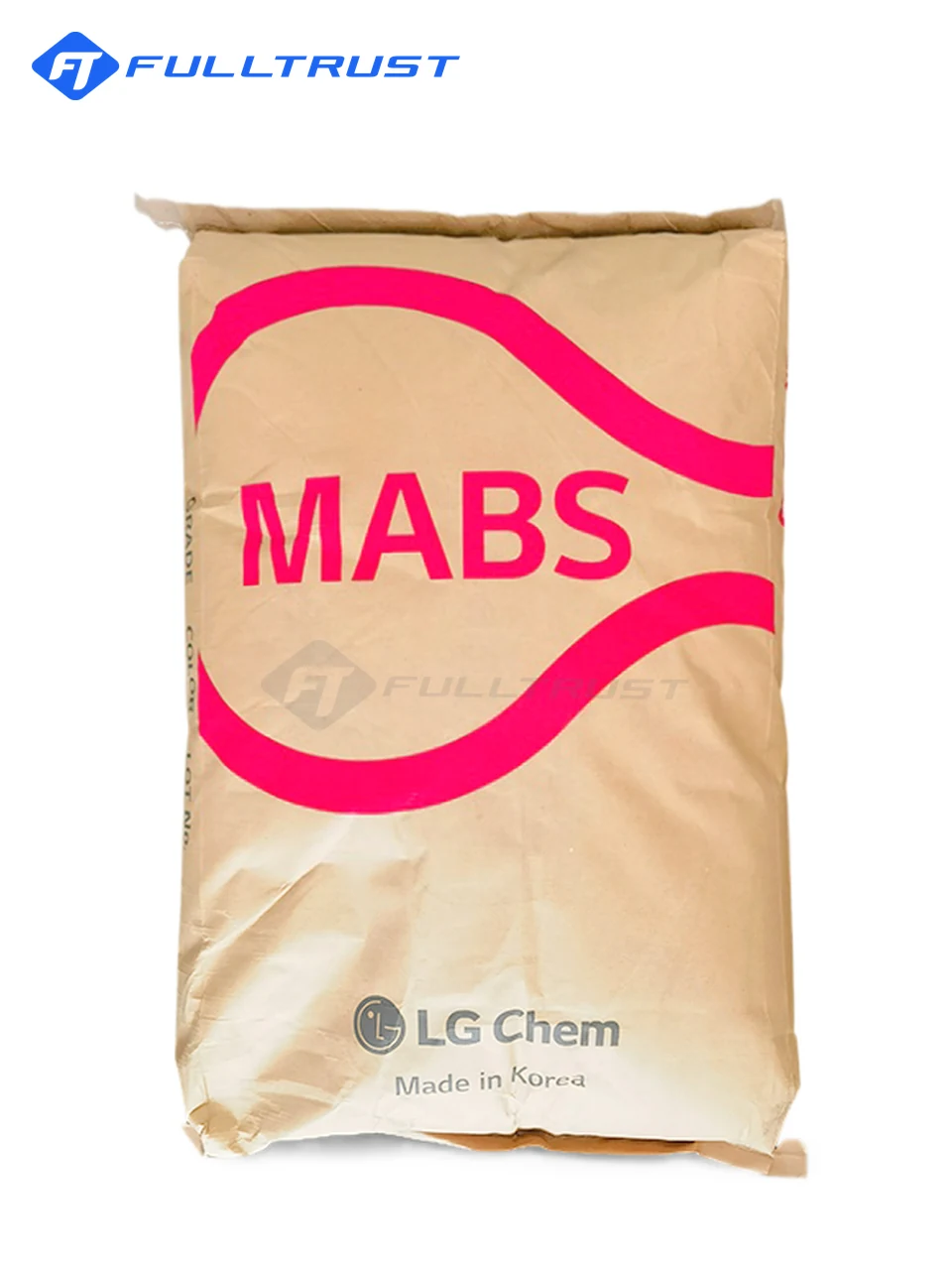
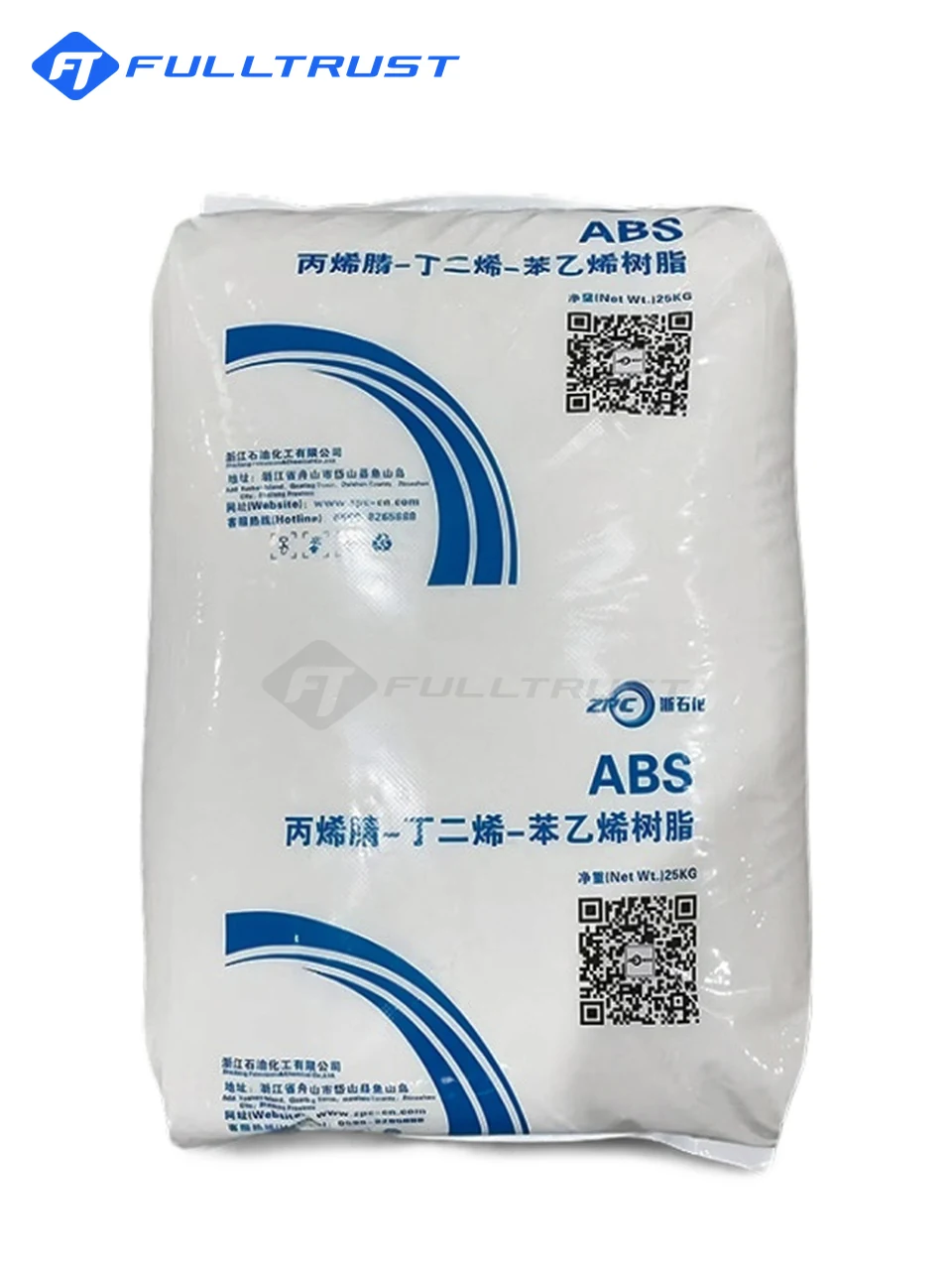
In general-purpose ABS, we supply CHIMEI PA-757 and PA-757K, INEOS Styrolution Terluran GP-22 and Terluran GP-35, and Chinese grades including Hengli HA-714, Yulong A-2020, ZPC ZA0210 and ZPC ZA0211. For higher impact, Terluran HI-10 and LG Chem HI121H are common choices. Our comparison of Chinese general-purpose ABS grades puts their published values side by side.
Because formulations differ between producers, always confirm tensile values on the official datasheet for the exact grade. When choosing between high-impact and standard grades, check that the lower modulus of the high-impact grade still gives acceptable deflection under your loads.
Designing ABS Parts for Strength
Turning datasheet values into a part that lasts means allowing for everything the test bar never sees: long-term load, heat, corners, weld lines and real-world abuse. Most ABS failures we hear about come from parts designed to the full datasheet strength, or with sharp internal corners. A few simple rules prevent most of them. Use the list below as a checklist when sizing walls and features.
- Use the yield strength of ABS plastic, not break strength, as the limit, with a safety factor of about 2–4 depending on the consequences of failure.
- Keep sustained working stress to about 10 MPa or less at room temperature to limit creep, and lower above about 40 °C.
- Check strength and stiffness at the highest service temperature, not only at room temperature.
- Keep walls uniform and add stiffness with ribs instead of thicker walls.
- Avoid sharp internal corners; use radii of at least 0.25–0.5 times the wall thickness, and more where possible.
- Place gates so that weld lines form away from highly stressed areas.
- Design snap fits to a strain limit, about 1.5–2.5%, rather than to stress alone.
- Test molded parts under realistic loads, drops and temperatures before releasing production.
How much margin you need depends on the application. Our overview of what ABS is used for shows how housings, handles and trim parts typically balance stiffness, strength and impact.
How to Compare ABS Strength on a Datasheet
When you compare tensile strength, ABS plastic datasheets from different producers often look inconsistent, and the difference is usually in the test method rather than the material. If you compare numbers measured differently, you may reject a good grade or approve a weaker one. A short check before comparing avoids this. Use the points below whenever you put two datasheets side by side.
- Same standard and speed. Check ISO 527 or ASTM D638, and the test speed for yield (for example 50 mm/min).
- Yield or break. Make sure both values are tensile strength at yield, or both at break.
- Conditioning. For comparison materials such as PA, check whether values are dry as molded or conditioned.
- Typical or minimum. Most datasheet values are typical averages, not guaranteed minimums.
- Lot documents. Ask for a COA for each lot to monitor consistency.
Our guide on how to read an ABS technical data sheet explains each line in detail. For cost context when weighing a stronger grade against a standard one, see our analysis of the ABS price in 2026.
Related reading
- ABS material properties: mechanical, thermal, chemical and electrical properties in one overview
- ABS melting point: glass transition, melt temperature and heat resistance
- ABS density: values in g/cm³, kg/m³ and lb/in³, and how density affects part weight
- What ABS is used for: applications by industry and the grades that fit them
Frequently Asked Questions
Is ABS stronger than PLA for 3D printing?
How much weight can an ABS part hold?
Does adding glass fiber always make ABS better?
Is PC/ABS worth the extra cost for strength?
Does regrind reduce the tensile strength of ABS?
Can you supply ABS with a guaranteed minimum tensile strength?
What documents come with an ABS shipment?
What payment terms do you accept for ABS orders?
To sum up: general-purpose ABS resin offers a tensile yield strength of about 40–50 MPa, a modulus of about 2.0–2.6 GPa and high impact toughness. It is not the strongest plastic in pure tension, but it is strong enough for most housings and handled parts when designed with sensible margins. Share your part geometry, load and operating temperature, and we will recommend suitable grades, send the datasheets and quote. Request an ABS quote