The density of ABS plastic is about 1.03–1.07 g/cm³ (1,030–1,070 kg/m³), and most general-purpose grades sit around 1.04–1.05 g/cm³. Flame-retardant and glass-filled ABS grades are denser, at about 1.12–1.28 g/cm³.
Behind most questions about ABS density there is a practical task. You may need to turn a CAD volume into a part weight, estimate resin cost per part for a quote, compare ABS with PP, HIPS or PC, or check whether the density on a datasheet or COA matches what you expected. In each case, a single average figure is not quite enough: you need the right value for the grade, in the right unit, and a clear idea of how to use it.
As an ABS supplier, we answer these questions for molders and procurement teams every week. This guide gives the typical ABS plastic density in metric and imperial units, explains why density changes from grade to grade, compares ABS with other common plastics, and shows step by step how to use density to calculate part weight, resin cost and the effect of switching materials. It ends with what to check on the datasheet and how to choose an ABS resin grade when weight matters.
ABS density at a glance
- Typical density. 1.03–1.07 g/cm³; general-purpose grades about 1.04–1.05 g/cm³.
- Other units. 1.05 g/cm³ = 1,050 kg/m³ = about 0.0379 lb/in³ = about 65.5 lb/ft³.
- Grade differences. Flame-retardant grades about 1.15–1.20 g/cm³; glass-filled grades up to about 1.28 g/cm³.
- Versus other plastics. About the same as polystyrene, about 16% heavier than PP and about 13% lighter than PC.
- Part weight. Volume (cm³) × density (g/cm³) = weight (g).
- On the datasheet. Check the test method (ISO 1183 or ASTM D792) and confirm the value for your exact grade.
What Is the Density of ABS Plastic?
If you are working on a part weight or a quote, you need a number you can put straight into a calculation. The difficulty is that density appears in different units depending on who you ask: a datasheet from Asia or Europe lists g/cm³, a toolmaker in the US may work in lb/in³, and a logistics planner thinks in kg/m³. Some datasheets also list specific gravity instead of density. This section gives the density of ABS in each unit, explains how density and specific gravity relate, and shows how the figure is measured so you know what it represents.
ABS Density in g/cm³, kg/m³ and lb/in³
Unfilled ABS has a density of about 1.03–1.07 g/cm³, or 1,030–1,070 kg/m³. In imperial units that is about 0.0372–0.0387 lb/in³ or 64.3–66.8 lb/ft³. When you do not yet have the datasheet for the exact grade, 1.05 g/cm³ is a sensible working value for general-purpose ABS.
| Unit | Typical range for ABS | Value at 1.05 g/cm³ |
|---|---|---|
| g/cm³ | 1.03–1.07 | 1.05 |
| kg/m³ | 1,030–1,070 | 1,050 |
| lb/in³ | 0.0372–0.0387 | 0.0379 |
| lb/ft³ | 64.3–66.8 | 65.5 |
Most CAD packages calculate part mass directly once you enter the density, in whichever unit the model uses. Entering the value for the actual grade, rather than a generic figure, avoids small errors that add up over large production volumes.
Density vs Specific Gravity: Are They the Same?
Not quite, but for ABS they give almost the same number. Density is mass per unit volume and has units, such as g/cm³ or kg/m³. Specific gravity is the ratio of a material’s density to the density of water at a stated temperature, so it has no units.
Because water has a density of about 1 g/cm³, the specific gravity of ABS, about 1.03–1.07, is numerically almost the same as its density in g/cm³. If a datasheet lists a specific gravity of 1.05, you can use 1.05 g/cm³ for part weight calculations without meaningful error.
How ABS Density Is Measured (ISO 1183 and ASTM D792)
Producers measure density using ISO 1183 or ASTM D792, normally at 23 °C. Both use the immersion method: a void-free molded specimen is weighed in air and then weighed while submerged in a liquid of known density, usually water. The difference gives the specimen’s volume, and from that its density.
Because the test uses a solid, void-free specimen, the result is the density of the material itself. A molded part with voids or sink marks can weigh slightly less than its volume and the datasheet density would suggest. When you compare datasheets, check that both quote the same standard and temperature.
Why Acrylonitrile Butadiene Styrene Density Varies by Grade
If you have compared datasheets from different producers, or from different grades of the same producer, you will have noticed that acrylonitrile butadiene styrene density is not one fixed value. The differences are small for standard grades but large for flame-retardant and filled grades, and they matter when you switch materials in an existing tool or estimate resin needs. Knowing where the differences come from helps you predict part weight changes before you sample. The main factors are the monomer balance, additives and fillers, and to a lesser extent color and regrind.
Monomer Ratio and Rubber Content
ABS is made of three building blocks: acrylonitrile, butadiene and styrene. The polybutadiene rubber is the lightest of the three, so grades with more rubber tend to be slightly less dense. High-impact ABS, which contains more rubber, typically measures about 1.03–1.04 g/cm³, while general-purpose ABS sits at about 1.04–1.05 g/cm³.
Heat-resistant ABS modifies the rigid phase, often with more acrylonitrile or with alpha-methylstyrene, and is typically slightly denser at about 1.05–1.07 g/cm³. These differences are small, usually within a few hundredths of a gram per cubic centimeter, but they explain why two “standard” ABS grades do not show exactly the same figure.
Flame Retardants, Glass Fiber and Other Additives
Additives cause the biggest density changes. Flame-retardant ABS rated UL 94 V-0 usually combines brominated flame retardants with an antimony trioxide synergist. Both are much denser than the polymer, so FR grades typically reach about 1.15–1.20 g/cm³.
Glass fiber has a density of about 2.5 g/cm³, so glass-filled ABS with 10–30% fiber reaches about 1.12–1.28 g/cm³ depending on the loading. Transparent ABS (MABS) is slightly denser than standard ABS at about 1.08 g/cm³, and PC/ABS blends fall between ABS and polycarbonate at about 1.10–1.15 g/cm³.
| ABS grade type | Typical density (g/cm³) | Typical use |
|---|---|---|
| High-impact ABS | 1.03–1.04 | Luggage, tool housings, protective cases |
| General-purpose ABS | 1.04–1.05 | Appliance and electronics housings, toys |
| Heat-resistant ABS | 1.05–1.07 | Automotive interior parts, parts near heat sources |
| Transparent ABS (MABS) | about 1.08 | Clear containers, covers and windows |
| PC/ABS blend | 1.10–1.15 | Automotive interiors, electronics housings |
| Flame-retardant ABS | 1.15–1.20 | Electrical enclosures, chargers, power supply housings |
| Glass-filled ABS (10–30%) | 1.12–1.28 | Stiff structural housings and brackets |
Additives also change flow and mold shrinkage, not just density. Before you put an FR or glass-filled grade into a tool designed for standard ABS, check the shrinkage and processing data on its datasheet.
Color, Masterbatch and Regrind
Color has a small effect. White masterbatch carries titanium dioxide, which has a density above 4 g/cm³, so high-opacity whites at 2–4% let-down can raise part density by about 0.01–0.02 g/cm³. Black and most organic colors make no practical difference.
Clean regrind from the same grade has essentially the same density as virgin material. A noticeable change usually means contamination, for example with a filled or heavier polymer, which is one reason density is a useful incoming check.
ABS Material Density vs Other Plastics
When you are choosing between materials, density tells you how heavy the same part will be in each one, and that affects product weight, freight and resin cost per part. ABS material density sits in the middle of the common thermoplastics: heavier than polyolefins, about the same as polystyrene and lighter than most engineering plastics. The table below puts the numbers side by side. It also shows which plastics float in water, which matters in recycling.
| Material | Density (g/cm³) | In water | Note |
|---|---|---|---|
| PP | 0.90–0.91 | Floats | Lightest common rigid plastic |
| LDPE | 0.91–0.93 | Floats | Film and flexible parts |
| HDPE | 0.94–0.96 | Floats | Containers, pipe, crates |
| HIPS | 1.03–1.05 | Sinks | Almost the same as ABS |
| GPPS | 1.04–1.05 | Sinks | Clear, brittle polystyrene |
| ABS | 1.03–1.07 | Sinks | General-purpose about 1.04–1.05 |
| ASA | about 1.07 | Sinks | Outdoor alternative to ABS |
| PA6 | about 1.13 | Sinks | Unfilled nylon |
| PMMA | about 1.18 | Sinks | Acrylic |
| PC | about 1.20 | Sinks | Polycarbonate |
| PET | 1.33–1.38 | Sinks | Bottles, fiber, sheet |
| PVC (rigid) | 1.35–1.45 | Sinks | Pipe and profiles |
| POM | about 1.41 | Sinks | Acetal for gears and clips |
ABS and HIPS have almost the same density, so moving a part between them barely changes its weight. Shrinkage is also similar, which is why the two are often trialed in the same tools, although the final choice depends on impact, gloss and cost.
Compared with PP, ABS is about 16% heavier for the same part volume, which is worth remembering when PP is considered for lightweighting. Compared with PC, PVC, PET and POM, ABS is lighter. Because ABS is denser than water, it sinks, while PP and PE float. Recyclers use this difference in sink-float tanks to separate polyolefins from styrenics and engineering plastics.
How to Use ABS Density in Practice
For most procurement and engineering teams, density is a means to an end: a part weight for the quote, a resin cost per part, or the tonnage needed for next year’s program. Getting these numbers right early avoids surprises when the first parts are weighed or the first invoice arrives. The calculations are simple, but it is easy to mix up solid density and bulk density or to forget runners and scrap. The examples below show how to apply ABS density step by step.
Calculating Part Weight from Volume
Part weight is volume multiplied by density. Your CAD model gives the part volume in cm³; multiply it by the grade’s density in g/cm³ to get the weight in grams.
For example, a housing with a volume of 120 cm³ molded in general-purpose ABS at 1.05 g/cm³ weighs 120 × 1.05 = 126 g. The same housing in flame-retardant ABS at 1.18 g/cm³ weighs 120 × 1.18 = 141.6 g, or about 142 g, roughly 12% more, even though the tool is the same.
Actual molded weights can differ by a few percent from the calculated figure, depending on packing pressure, shrinkage and any voids or sink marks. Use the calculation for quoting and planning, and confirm it by weighing first-shot parts.
Estimating Resin Cost per Part
Resin cost per part is part weight in kilograms multiplied by the resin price per kilogram. Using the 126 g housing above and an illustrative price of USD 1.80/kg (for illustration only, not a market quote), the resin cost is 0.126 × 1.80 = about USD 0.23 per part.
For a realistic estimate, add the weight of runners and sprues if they are not reground, and allow for start-up scrap. Because resin is priced by weight, a denser grade costs more per part even at the same price per kilogram. For current market levels, see our analysis of the ABS price in 2026.
Switching Materials: What Happens to Part Weight
When you run a different material in the same tool, part weight changes roughly in proportion to the density ratio. This affects resin tonnage, packaging weight and freight. The table below shows typical changes for common switches.
| Change | Density ratio | Approximate weight change |
|---|---|---|
| PP (0.905) to ABS (1.05) | 1.16 | About 16% heavier |
| HIPS to ABS | 1.00–1.01 | About 0–1% |
| ABS (1.05) to FR ABS (1.18) | 1.12 | About 12% heavier |
| ABS to PC/ABS | 1.05–1.10 | About 5–10% heavier |
| ABS (1.05) to PC (1.20) | 1.14 | About 14% heavier |
When you switch, remember that shrinkage and processing also change, so first parts may need tool or process adjustments. Recalculate the annual resin requirement with the new density so the order quantity matches the program.
Bulk Density, Dryer Sizing and Storage
Pellets do not pack solidly; there is air between them. The bulk density of ABS pellets is therefore lower than the solid density, typically about 0.60–0.65 g/cm³ (600–650 kg/m³). Use bulk density, not solid density, when sizing hoppers, dryers and silos.
For example, a dryer hopper that must hold 500 kg of ABS needs about 500 ÷ 600 = 0.83 m³ of volume at 600 kg/m³. Sizing on solid density would give a hopper that is too small and a drying time that is too short. Drying temperature and time for common grades are listed in our table of ABS drying and molding conditions by grade.
Density on the Datasheet and COA: What to Check
Density is one of the simplest values on a datasheet, but it is also one of the most useful for spotting problems. When an incoming lot looks or runs differently from the last one, a quick density check can show whether you have received a different grade, a filled compound or contaminated material. It is just as important to know what density does not tell you. Here is what to look for on the datasheet and COA, and how to use density in incoming inspection.
On a technical datasheet, density usually appears in the physical properties section next to melt flow rate and mold shrinkage, with the test standard (ISO 1183 or ASTM D792) and units. Make sure you compare values measured by the same method. Our guide on how to read an ABS technical data sheet explains the other properties on the same page.
The COA for each lot usually reports melt flow and impact strength; density is listed on some producers’ COAs but not all. If density matters for your process or customer, ask for it at the quotation stage.
For incoming inspection, small differences of about ±0.01 g/cm³ from the datasheet value are normal lot-to-lot variation. A difference of 0.02 g/cm³ or more suggests a different formulation, a filler, or contamination, and deserves a closer look. Density alone does not confirm impact strength, melt flow or heat resistance, so combine it with a melt flow test and, where needed, a molding trial.
Choosing an ABS Grade When Weight Matters
In some products every gram counts: handheld tools and devices, automotive interior parts under weight targets, or products shipped in large volumes where freight is a real cost. In others, a heavier grade is the price of meeting a fire-safety rule or a stiffness requirement. The right choice depends on which requirement comes first. The points below help you balance density against the other properties your part needs.
When low weight matters, start with unfilled general-purpose or high-impact ABS, which are the lightest ABS options. Reduce part weight further through design: thinner walls supported by ribs usually save more weight than any change of grade. Avoid specifying flame retardants or fillers that the application does not actually require.
When higher density is accepted, it is usually because of a requirement that cannot be avoided. Electrical enclosures that must meet UL 94 V-0 need flame-retardant ABS at about 1.15–1.20 g/cm³, and parts that need extra stiffness may use glass-filled ABS at up to about 1.28 g/cm³. Heat requirements can also push you toward heat-resistant ABS or PC/ABS, both slightly denser; see our guide to the ABS melting point and heat resistance, and our overview of what ABS is used for for typical applications.
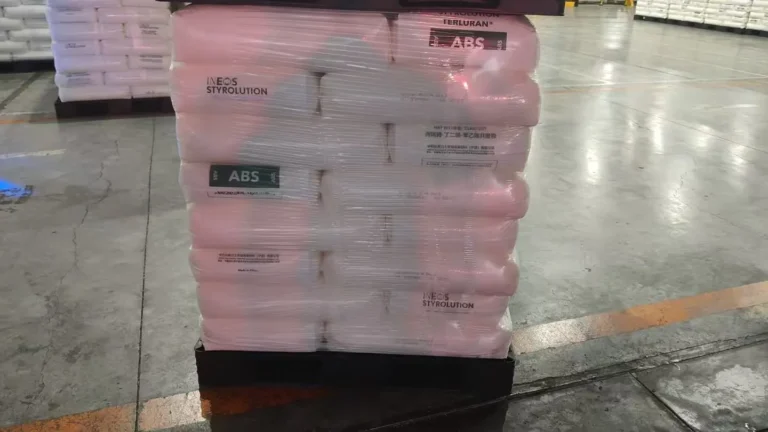
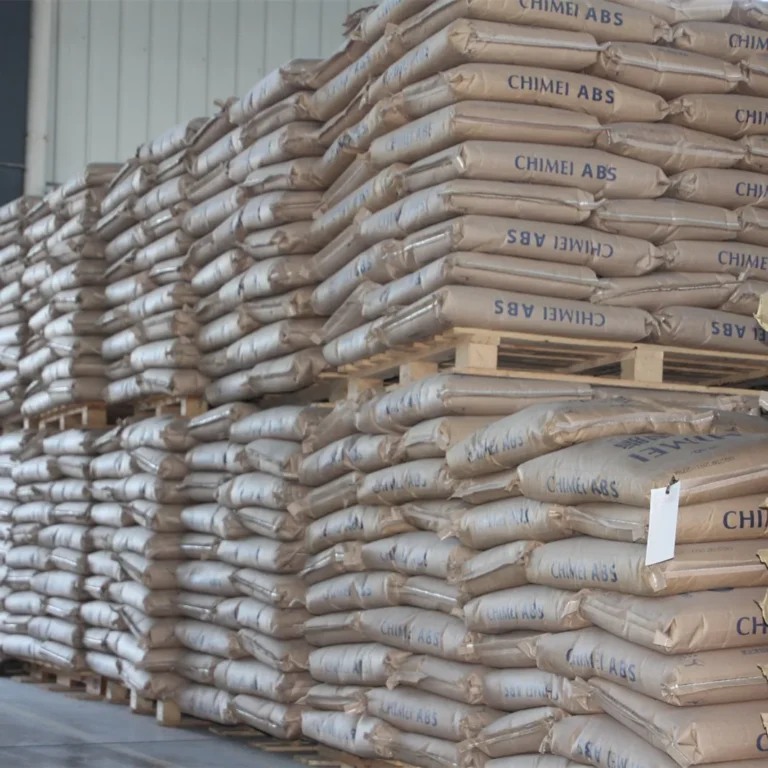
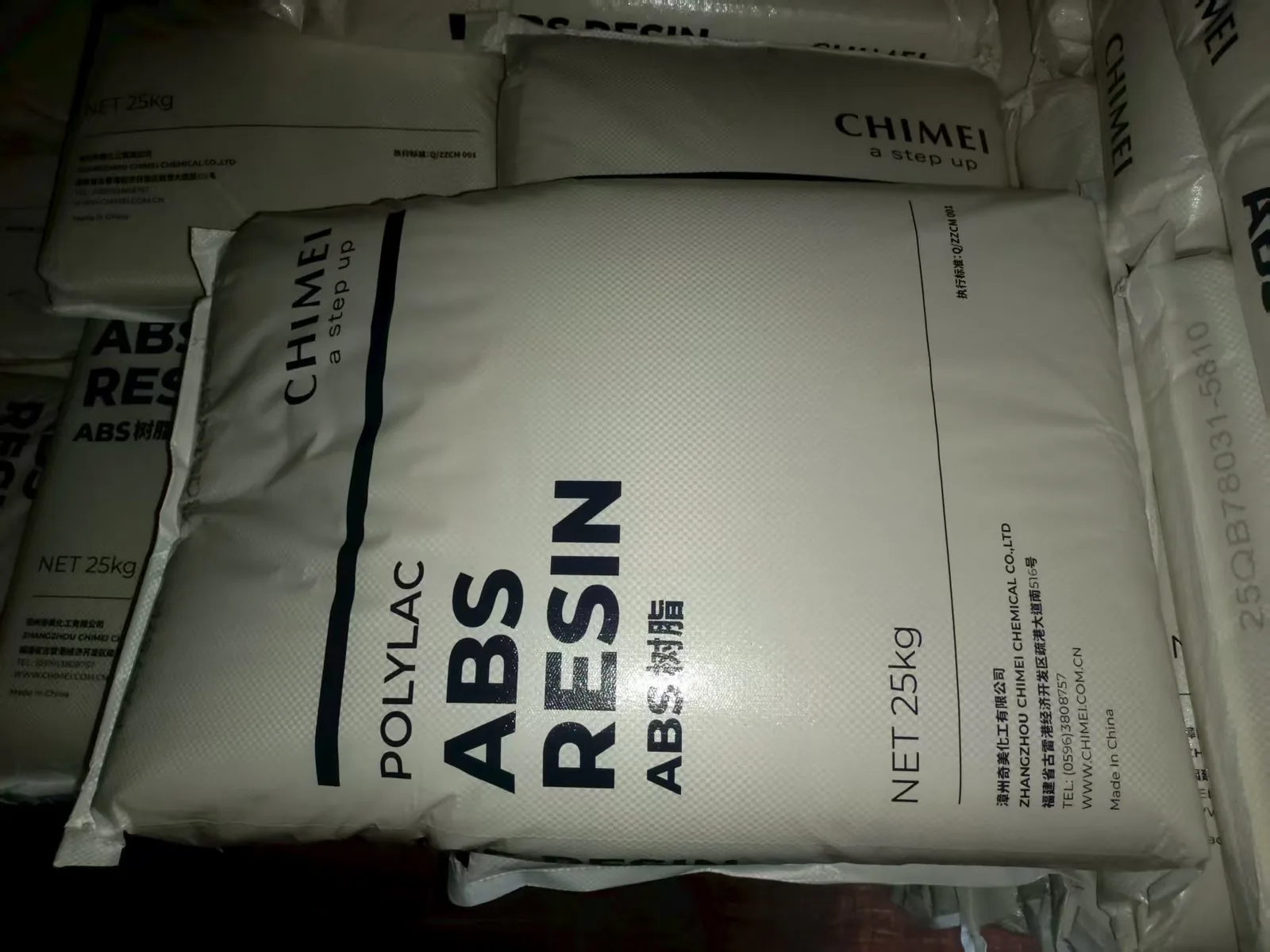
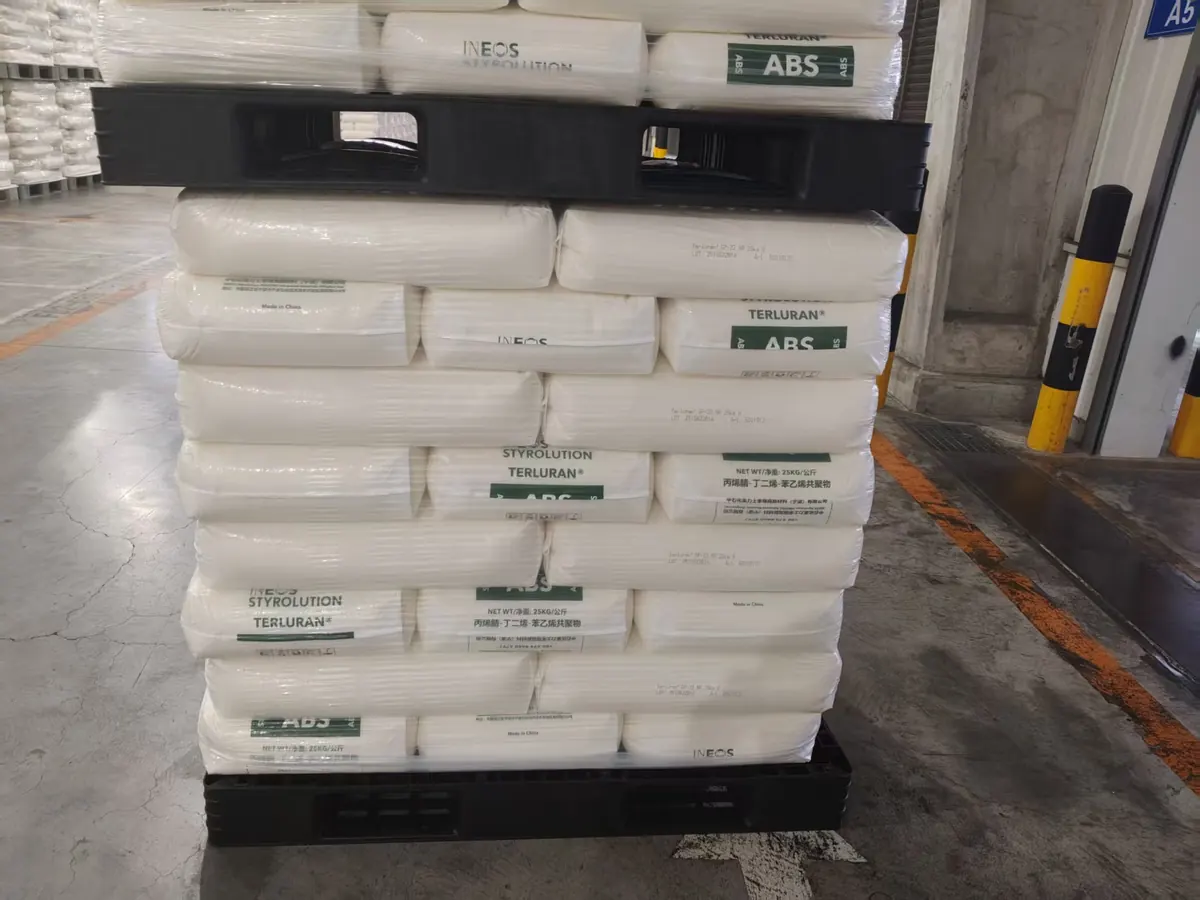
Among the grades we supply, general-purpose options include CHIMEI PA-757 and PA-757K, INEOS Styrolution Terluran GP-22 and Terluran GP-35, and Chinese grades such as Hengli HA-714, Yulong A-2020, ZPC ZA0210 and ZPC ZA0211. For higher impact, Terluran HI-10 and LG Chem HI121H are common choices. Confirm the density of each grade on the producer’s datasheet, and see our comparison of Chinese general-purpose ABS grades for their published values side by side.
Frequently Asked Questions
Does ABS density change with temperature?
Is ABS lighter than PLA for 3D printing?
Can density tell me whether an ABS shipment contains regrind?
Why does my molded ABS part weigh more or less than the calculated weight?
Do you quote ABS by weight or by volume?
Is density listed on the COA or only on the datasheet?
What documents come with an ABS shipment?
What payment terms do you accept for ABS orders?
To sum up: ABS has a density of about 1.03–1.07 g/cm³, with general-purpose grades around 1.04–1.05 g/cm³, while flame-retardant and glass-filled grades are heavier. Multiply part volume by the grade’s density for part weight, use part weight for resin cost and tonnage, and use bulk density for hoppers and dryers. Send us your part details and current grade, and we will recommend suitable ABS grades, send the datasheets and quote. Request a grade cross-reference