Drawings and material specifications from European and multinational OEMs often call out INEOS Terluran GP-22 for housings and general injection-molded parts. When those parts are molded in Asia, or when GP-22 is tight, the question that reaches our sales team is almost always the same: what can replace it, and how close is it?
The two grades most often offered are CHIMEI PA-757, CHI MEI’s best-known general-purpose grade and a common reference in Asia, and PetroChina 0215A, a widely available Chinese grade in the same class. This guide compares what each producer publishes, explains where the grades really differ, and sets out what a purchasing and engineering team needs before approving either one as an alternative to GP-22.
Summary for purchasing and engineering teams
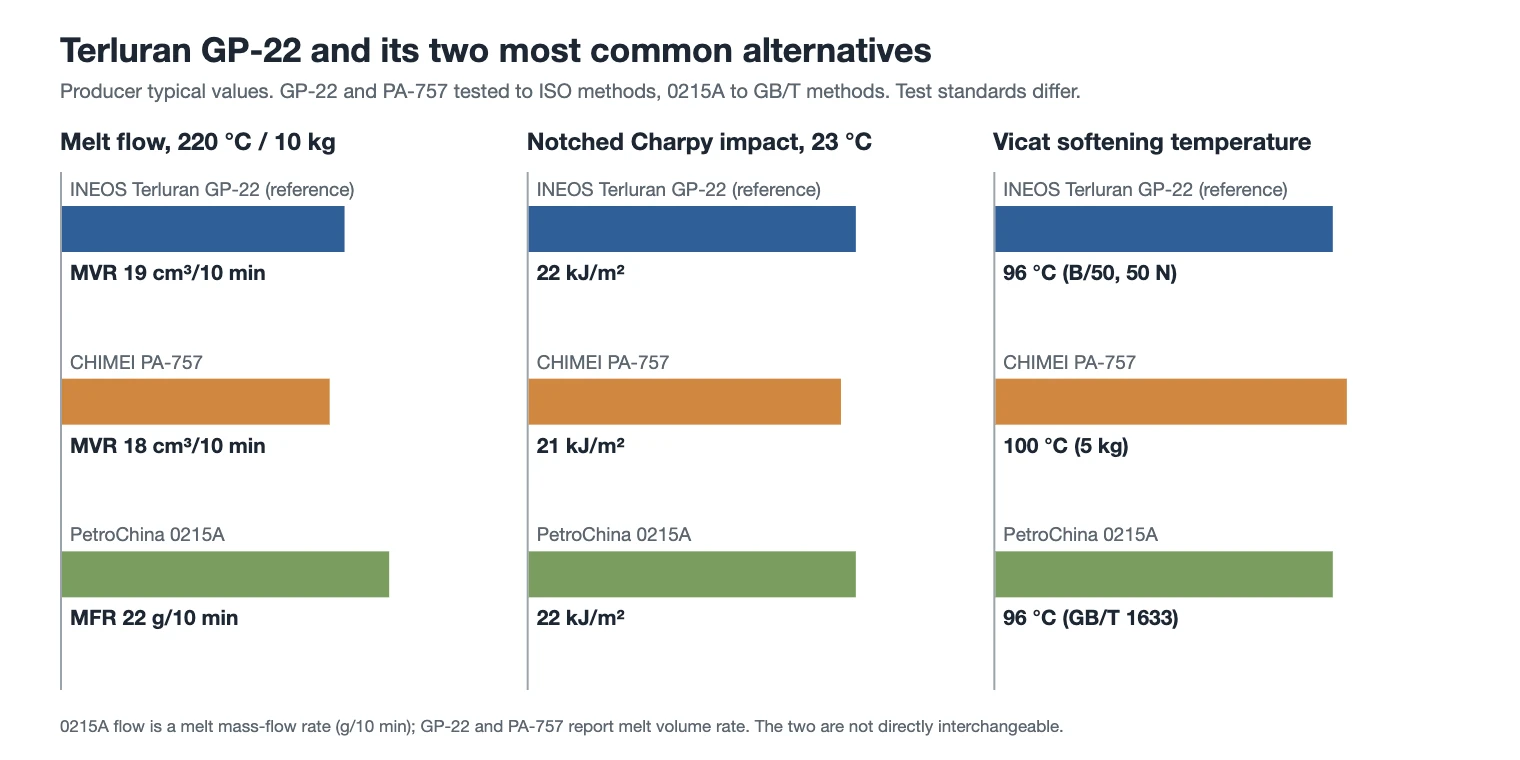
- Same flow class. GP-22 lists a melt volume rate of 19 cm³/10 min and PA-757 18 cm³/10 min at 220 °C/10 kg. PetroChina lists 0215A at a typical melt mass-flow rate of 22 g/10 min under the same conditions.
- Close, not identical. PA-757 and 0215A list higher flexural strength than GP-22, and PA-757 higher heat resistance; GP-22 lists higher Izod impact. None is a certified equivalent of another.
- Different test standards. GP-22 and PA-757 are documented with typical values under ISO methods, 0215A with typical values under GB/T methods. Compare certificates of analysis (COAs) and trial results, not data sheets alone.
- Approval comes first. Where the drawing names GP-22, or the part carries a UL or regulatory listing, an alternative needs customer approval and grade-specific documents before it can ship.
Why PA-757 and 0215A are the usual alternatives
An alternative to GP-22 has to match three things before any detailed comparison is worth making: the same flow class, so the part fills on the existing tool and process; the same balance of impact and stiffness for housings; and reliable availability in the region where the parts are molded.
- PA-757 meets all three. Its ISO data sheet lists almost the same MVR as GP-22 (18 against 19 cm³/10 min), similar notched Charpy impact, and the producer describes it as a high-gloss, medium-impact general grade. It is widely available in Asia.
- 0215A sits in the same flow range and is PetroChina’s general-purpose injection grade, described by the producer as high gloss and high rigidity with a good stiffness-to-toughness balance. It is usually considered when imported grades are tight or when the part is made for the domestic market.
INEOS Styrolution describes GP-22 itself as an easy-flow, general-purpose injection grade with high impact and heat distortion resistance, intended mainly for housings, with excellent colorability and high surface gloss. Those are the properties an alternative has to be checked against.
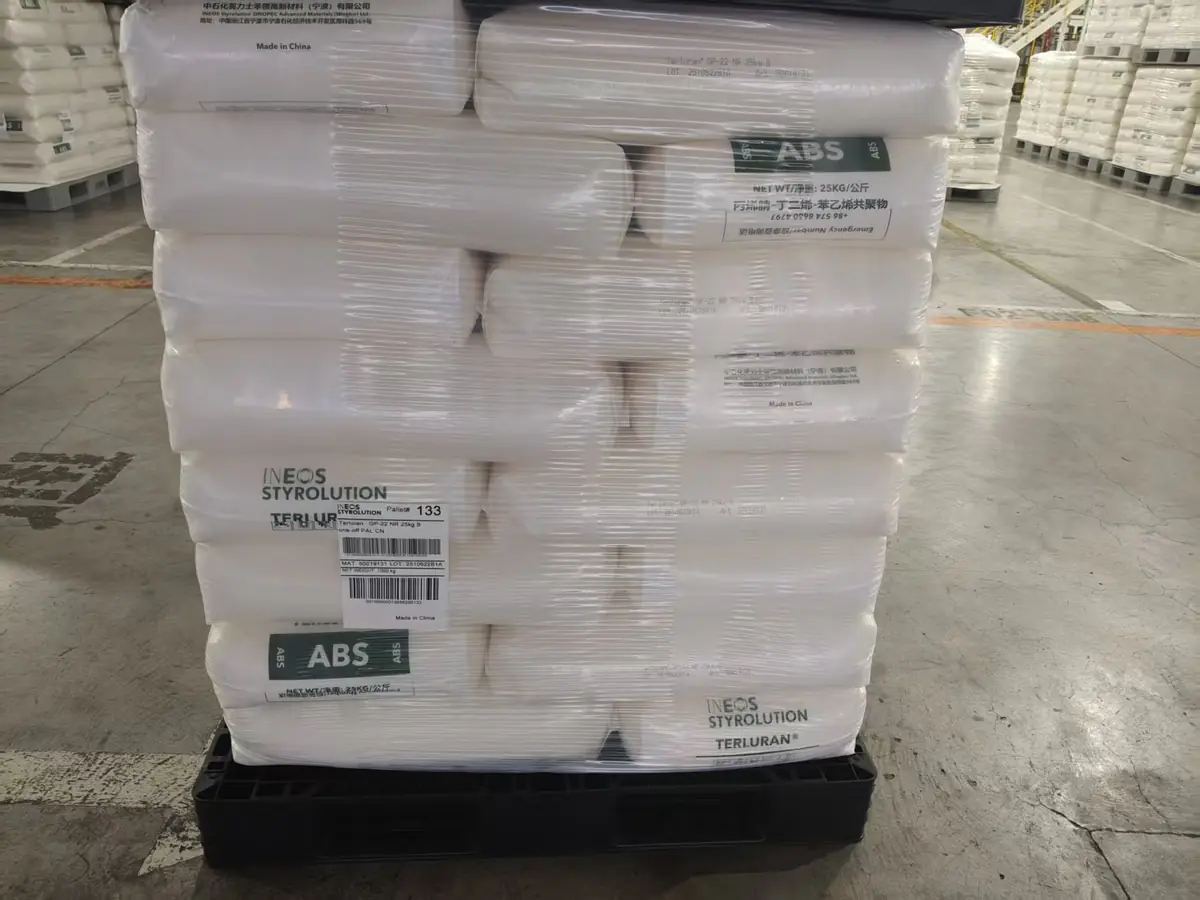
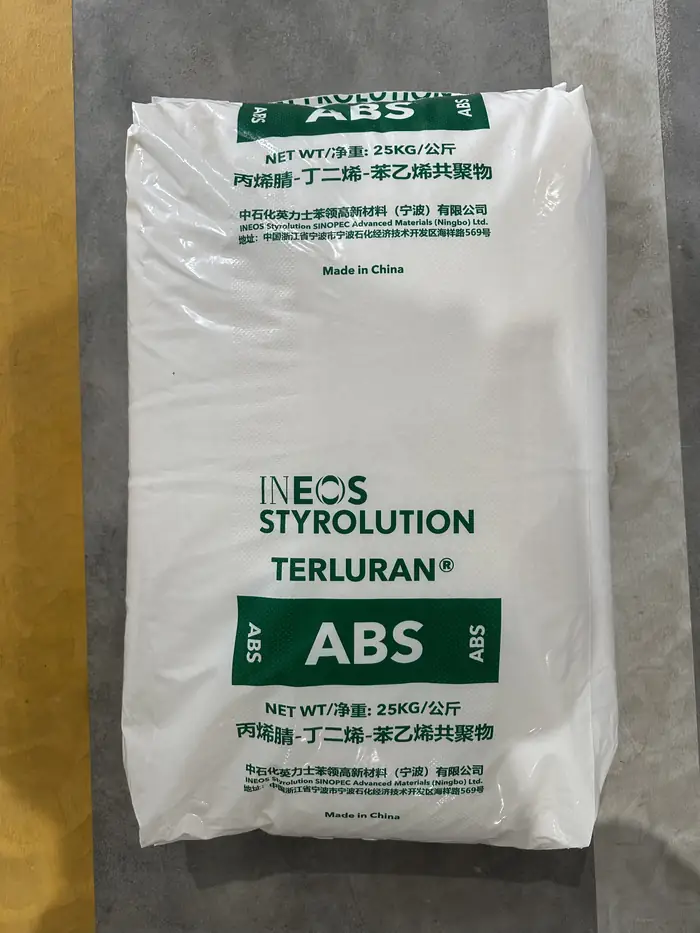
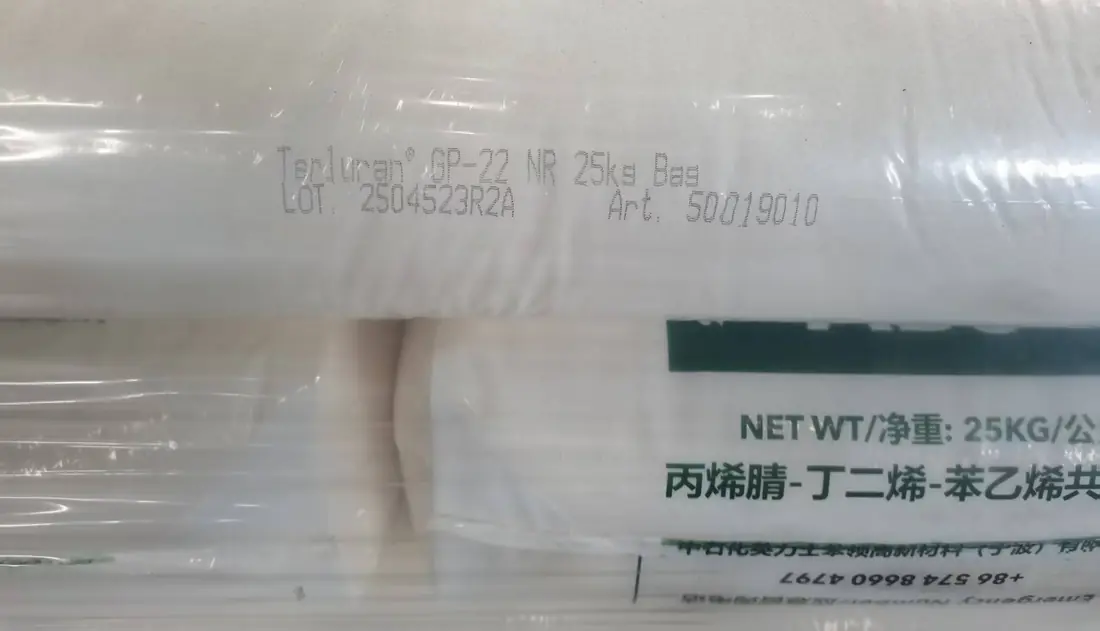
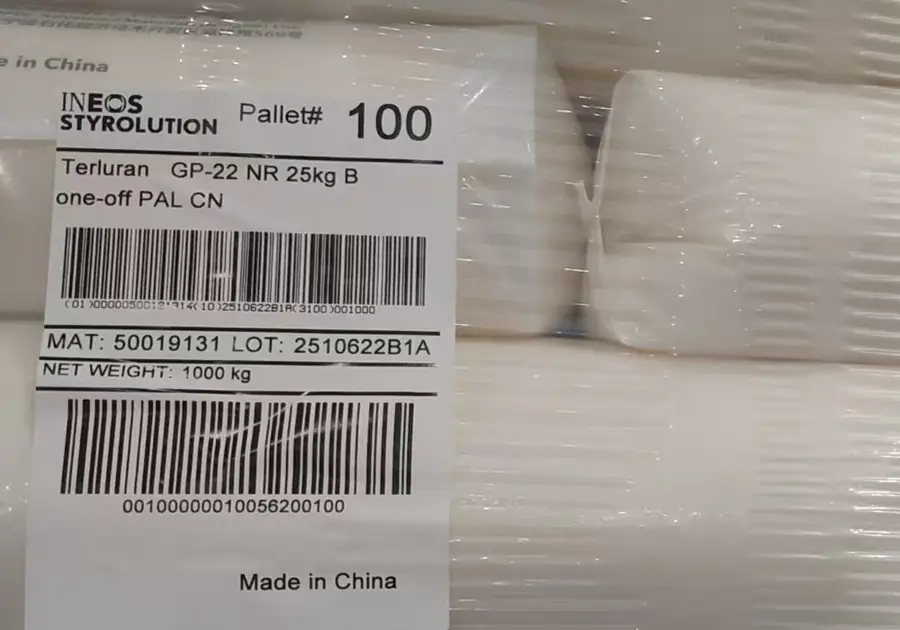
Before looking at alternatives, check whether GP-22 itself can be sourced locally. GP-22 bags we handle are printed with INEOS Styrolution SINOPEC Advanced Materials (Ningbo) Ltd. as the producer and marked Made in China, so for parts molded in China the original grade may be available without a substitution.
Data-sheet values
The table sets out what each producer publishes. All values are typical values from the producers’ data sheets: ISO methods for GP-22 and PA-757, GB/T methods for 0215A (PetroChina Jilin Petrochemical, Jieyang). Where a property is not given, the cell shows “/”.
| Property | INEOS Terluran GP-22 | CHIMEI PA-757 | PetroChina 0215A |
|---|---|---|---|
| Basis of values | Typical, ISO | Typical, ISO | Typical, GB/T |
| Melt flow, 220 °C / 10 kg | MVR 19 cm³/10 min | MVR 18 cm³/10 min | MFR 22 g/10 min |
| Density | 1,040 kg/m³ | 1.05 g/cm³ | / |
| Tensile stress at yield | 45 MPa | 47 MPa | 45 MPa |
| Tensile modulus | 2,300 MPa | / | / |
| Flexural strength | 65 MPa | 76 MPa | 74 MPa |
| Flexural modulus | / | 2,200 MPa | 2,300 MPa |
| Charpy notched impact, 23 °C | 22 kJ/m² | 21 kJ/m² | 22 kJ/m² |
| Charpy notched impact, −30 °C | 8 kJ/m² | 10 kJ/m² | / |
| Izod notched impact, 23 °C | 26 kJ/m² | 19 kJ/m² | / |
| Vicat softening temperature, B (50 N) | 96 °C | 100 °C (5 kg) | 96 °C (GB/T 1633) |
| Vicat softening temperature, A (10 N) | 105 °C | 104 °C (1 kg) | / |
| HDT, 1.8 MPa, annealed | 94 °C | 98 °C | / |
| Hardness | Ball indentation 97 MPa | / | Rockwell R106 |
| Yellowness index | 13 (DIN 6167) | / | 20 (HG/T 3862) |
| Mold shrinkage | 0.4–0.7% | 0.4–0.7% | / |
| Flammability, UL 94 | / | HB at 1.5 mm | HB (UL certificate) |
Typical values are not specification limits. GB/T and ISO methods differ in specimen preparation and conditioning, so small differences between columns are not significant.
Where the grades differ
On paper, the three grades sit in the same performance class. The differences that matter for a substitution come from a few properties and from how the values are reported.
- Heat and stiffness: PA-757 is higher. Its typical Vicat B (100 °C) and annealed HDT (98 °C) are above GP-22 (96 °C and 94 °C), and its flexural strength (76 MPa) is well above GP-22 (65 MPa); 0215A is also stiffer in bending (74 MPa). For a part approved on GP-22, this is margin rather than risk.
- Izod impact: GP-22 is higher. 26 kJ/m² against 19 kJ/m² for PA-757 under the same ISO method, although Charpy results are close (22 against 21). Parts with snap fits, thin bosses or drop requirements should be tested before approval.
- Cold impact is published for two grades only. GP-22 lists 8 kJ/m² and PA-757 10 kJ/m² notched Charpy at −30 °C. For parts used outdoors in winter or in cold storage, request cold-impact data for 0215A or test it.
- MVR and MFR are different measurements. GP-22 and PA-757 report melt volume rate (cm³ or ml per 10 min); 0215A is specified by melt mass-flow rate (g per 10 min). The two are related through melt density but are not interchangeable figures. For incoming control, approve a range in the unit the COA actually uses.
- Charpy impact is close for all three. 0215A lists 22 kJ/m² notched Charpy, the same as GP-22 and just above PA-757 (21), although under a GB/T rather than ISO method.
- Natural color differs. GP-22 publishes a yellowness index of 13 (DIN 6167); 0215A lists 20 under HG/T 3862, a different standard. For white and light-colored parts, the same masterbatch may not give the same shade.
When a substitution needs customer approval
Matching data sheets is only part of the work. In many cases the grade cannot be changed without the customer’s approval and grade-specific documents:
| Situation | Why it matters | What is needed |
|---|---|---|
| The drawing or material specification names Terluran GP-22 | The grade is part of the approved design; changing it is a design change | Written customer approval, data comparison, samples and, for automotive parts, the customer’s change-approval process |
| Electrical enclosures with a UL listing | UL recognition is specific to the grade, color and thickness tested | Confirmation that the alternative grade is recognized for the required rating; PA-757 is listed as HB at 1.5 mm on its data sheet |
| Color-matched or white parts | Natural color and gloss differ between grades | Color trial against the master sample, gloss check on the production tool |
| Toys, food-contact or other regulated uses | Compliance declarations are issued per grade and producer | RoHS, REACH and application-specific declarations for the alternative grade |
| Parts used in the cold | Cold impact is published for GP-22 and PA-757 only | Low-temperature drop or impact test on the part |
| GP-22 used as the base of a color or modified compound | Base-resin properties carry through to the compound | Testing of the finished compound, not just the base resin |
Grade profiles
INEOS Terluran GP-22
A general-purpose injection grade aimed mainly at housings. The producer lists appliance housings, household and sanitary appliances, toys and automotive components among its applications. GP-22 has the most complete published data set of the three, including electrical properties, moisture absorption (0.22% at 23 °C/50% RH) and yellowness index. Material supplied in China is produced by INEOS Styrolution SINOPEC Advanced Materials (Ningbo) Ltd., as printed on the bag. Our catalog also lists the higher-flow Terluran GP-35 and the high-impact Terluran HI-10.
CHIMEI POLYLAC PA-757
A high-gloss, medium-impact general grade and a common reference for general-purpose ABS in Asia. Compared with GP-22, it lists higher heat and flexural values and lower Izod impact, with a UL 94 HB rating at 1.5 mm. CHI MEI sells several variants under the 757 number. Our catalog lists PA-757, 757K and the higher-flow PA-757H. An inquiry that says only “757” should be clarified before quoting.
PetroChina 0215A
A Chinese general-purpose ABS made by emulsion grafting blended with bulk SAN. The data sheet we hold is issued by PetroChina Jilin Petrochemical (Jieyang) Branch under product standard Q/SY 03063-2019, and the producer lists small appliances, electronic and electrical products, daily-use goods and toys as uses, with FDA, RoHS and GB 4806.6 certifications. The grade name is used by more than one PetroChina plant, so the plant should be named on the order. As an alternative to GP-22 it needs a trial, because its GB/T values are not directly comparable with ISO typical values.
Processing and drying
Because the three grades sit in the same flow class and list similar shrinkage, a change rarely needs tool modification. ABS absorbs moisture from the air, so it should be dried before molding; moisture shows up as splay (silver streaks) and can reduce impact strength.
| Parameter | GP-22 (producer guideline) | PA-757 | 0215A | Practical note |
|---|---|---|---|---|
| Drying | 80 °C, 2–4 h | / | 80–90 °C, 2 h | Use a dehumidifying dryer, and dry material from opened bags before use. |
| Melt temperature | 220–260 °C | / | 210–280 °C | Start from the GP-22 setting; raise temperature for long flow paths rather than raising pressure. |
| Mold temperature | 30–80 °C | / | / | Higher mold temperatures improve gloss and reduce visible weld lines. |
| Mold shrinkage | 0.4–0.7% | 0.4–0.7% | / | Same published range for GP-22 and PA-757. Confirm critical dimensions in a trial. |
Qualifying an alternative to GP-22
- Check whether approval is required. If the drawing names GP-22 or the part carries a UL or regulatory listing, agree the change with the customer before trials.
- Data review. Compare flow, notched impact at the lowest service temperature, Vicat or HDT and, for light colors, yellowness. Use documents from the producer and plant that will actually ship.
- Documentation. Collect the TDS and SDS and the compliance statements the part requires, such as RoHS, REACH or UL recognition.
- Molding trial. Run the alternative on the production tool with the GP-22 settings as the starting point. Record fill, cycle time, part weight, color and surface defects.
- Part testing and approval. Test impact, heat and dimensions on the part, then approve the grade with its producer and plant and check each lot’s COA against the approved range.
Supply and incoming inspection
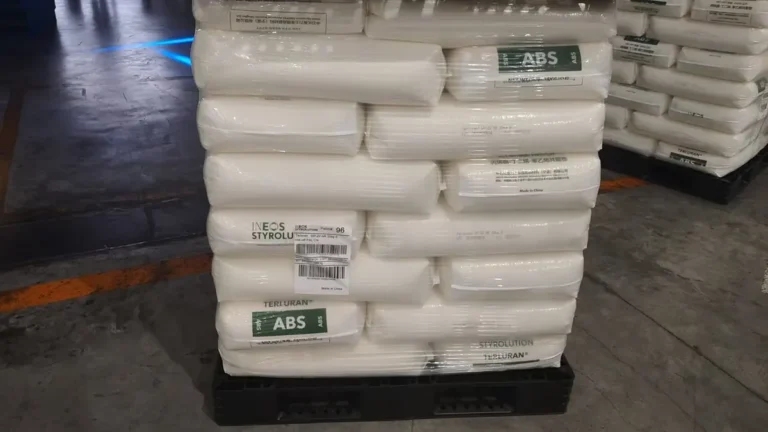
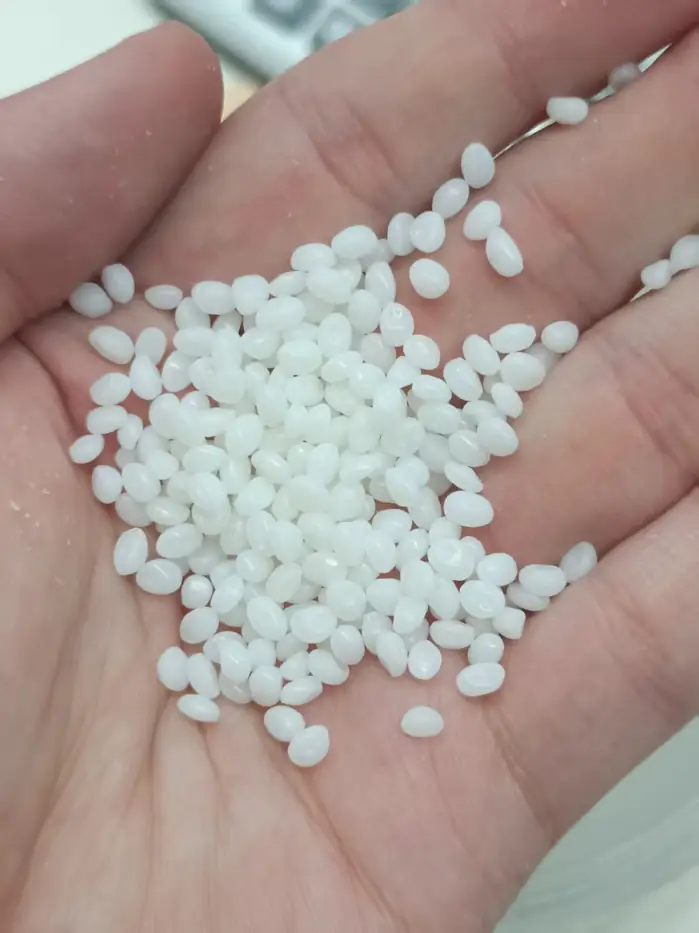
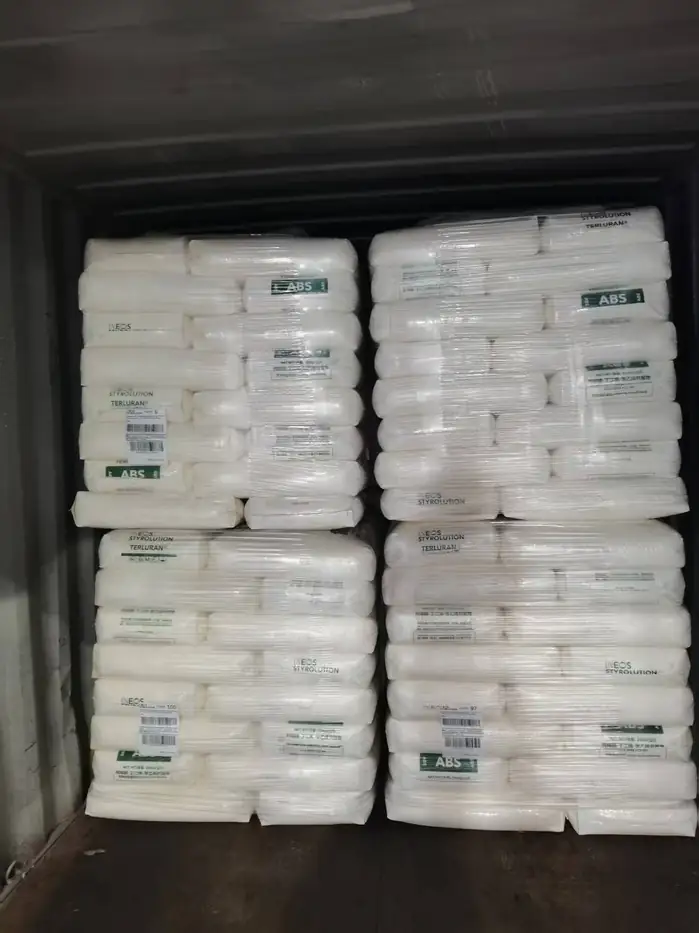
All three grades are usually supplied as natural pellets in 25 kg bags, palletized for shipment. At goods-in, check that:
- Producer, plant and grade on the bag match the purchase order. For 0215A this includes the producing plant; for “757” it includes the exact variant.
- The lot number on the bag matches the COA.
- Flow and impact on the COA fall within the range approved during qualification, in the same unit (MVR or MFR) used at approval.
General-purpose ABS in our catalog
| Grade | Flow as published | Basis | Positioning |
|---|---|---|---|
| INEOS Terluran GP-22 | MVR 19 cm³/10 min (220 °C/10 kg) | Typical, ISO | General-purpose injection, housings |
| CHIMEI PA-757 | MVR 18 cm³/10 min (220 °C/10 kg) | Typical, ISO | High gloss, medium impact |
| CHIMEI 757K | MVR 18 cm³/10 min (220 °C/10 kg) | Typical, ISO | Same data sheet values as PA-757 |
| CHIMEI PA-757H | 28.0–32.0 g/10 min (220 °C/10 kg) | Specification limits | Higher flow for thin walls and long flow paths |
| PetroChina 0215A | 22 g/10 min (220 °C/10 kg) | Typical, GB/T | Domestic general-purpose grade |
| Hengli HA-714 | 20.0–23.0 g/10 min | Specification limits, GB/T | Domestic general-purpose grade |
| ZPC ZA0210 | 20 g/10 min (220 °C/10 kg) | Typical, GB/T | Domestic general-purpose grade |
All grades are listed under ABS resin.
Frequently asked questions
Is CHIMEI PA-757 equivalent to Terluran GP-22?
Can PetroChina 0215A replace GP-22?
The drawing specifies Terluran GP-22. Can the molder switch grades on its own?
What does “757” mean in an inquiry?
Why are the flow figures in different units?
Is 0215A from Jilin the same as 0215A from Jieyang?
Can an alternative be used for UL-listed enclosures?
Does ABS need drying before molding?
PA-757 and 0215A are the practical alternatives when GP-22 is called out but not available, and on paper both sit close to it. What decides whether a substitution works is the approval route, the properties the part depends on, and the consistency of the lots that arrive. Purchasing teams that clarify approval first, name the producer, plant and exact grade, and approve incoming ranges in the right units can change grades without surprises.