ZA0211 and ZA0210 are the two general-purpose injection-molding ABS grades from Zhejiang Petroleum & Chemical Co., Ltd. (ZPC) that purchasing teams most often compare. Both are produced at ZPC’s integrated refining and chemical complex on Yushan Island, Zhoushan, both are supplied as natural pellets in 25 kg bags, and both are widely used for appliance and electrical housings.
On paper the two grades are very close. This guide sets out what ZPC’s certificates show for each grade, where they differ, how they compare with imported general-purpose ABS, and what to check before approving either one.
Summary for purchasing and engineering teams
- Same specification limits. ZPC certifies both grades to a melt mass-flow rate of 18.0–24.0 g/10 min (220 °C/10 kg), tensile strength ≥ 40.0 MPa, flexural modulus ≥ 2,300 MPa and notched Charpy impact ≥ 16.0 kJ/m².
- Similar lot results. Recent certificates show MFR 20.3 and 21.0 g/10 min, notched Charpy 23 and 26 kJ/m², and Vicat softening temperatures of 94.3 and 95.4 °C for ZA0211 and ZA0210.
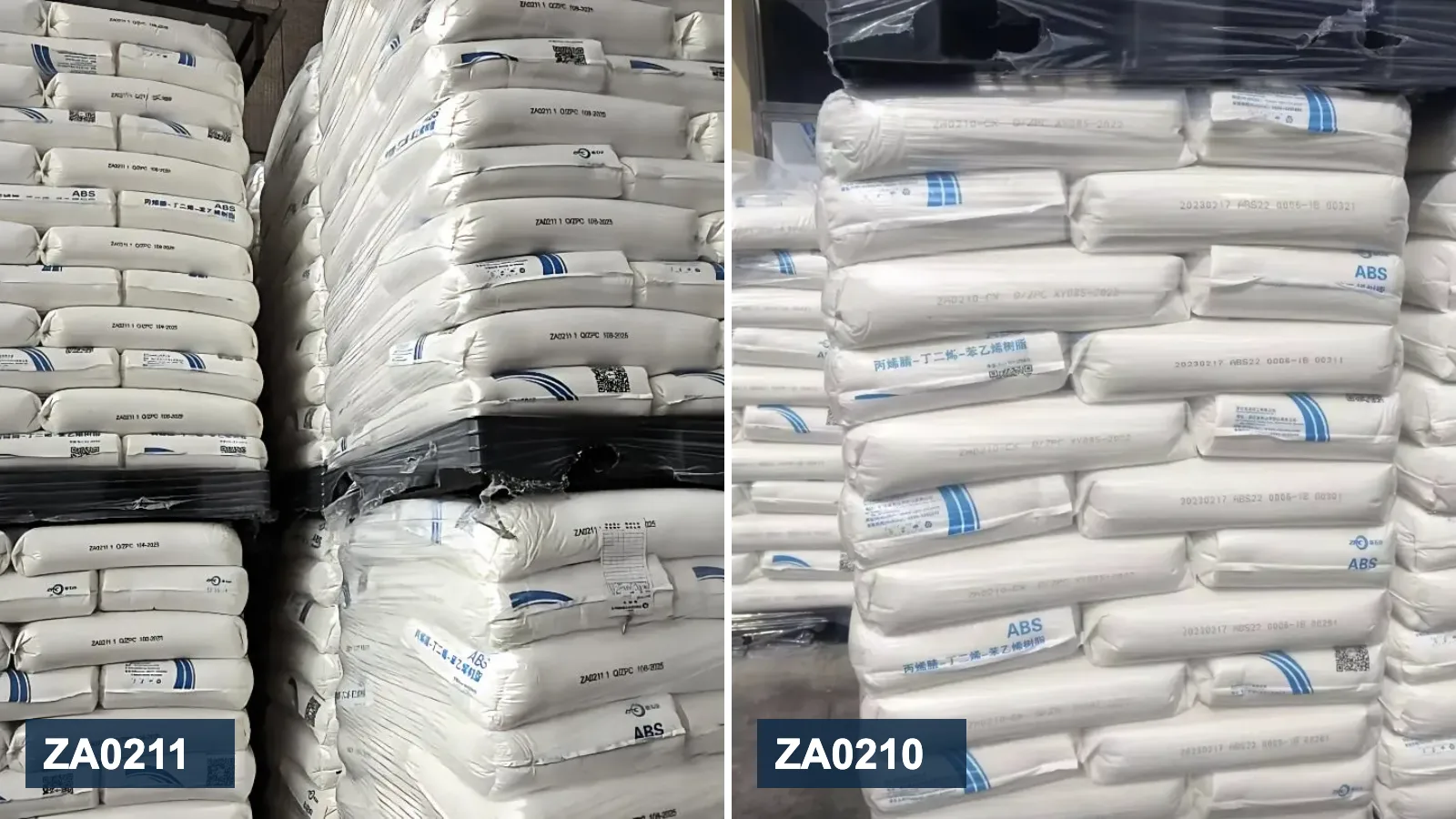
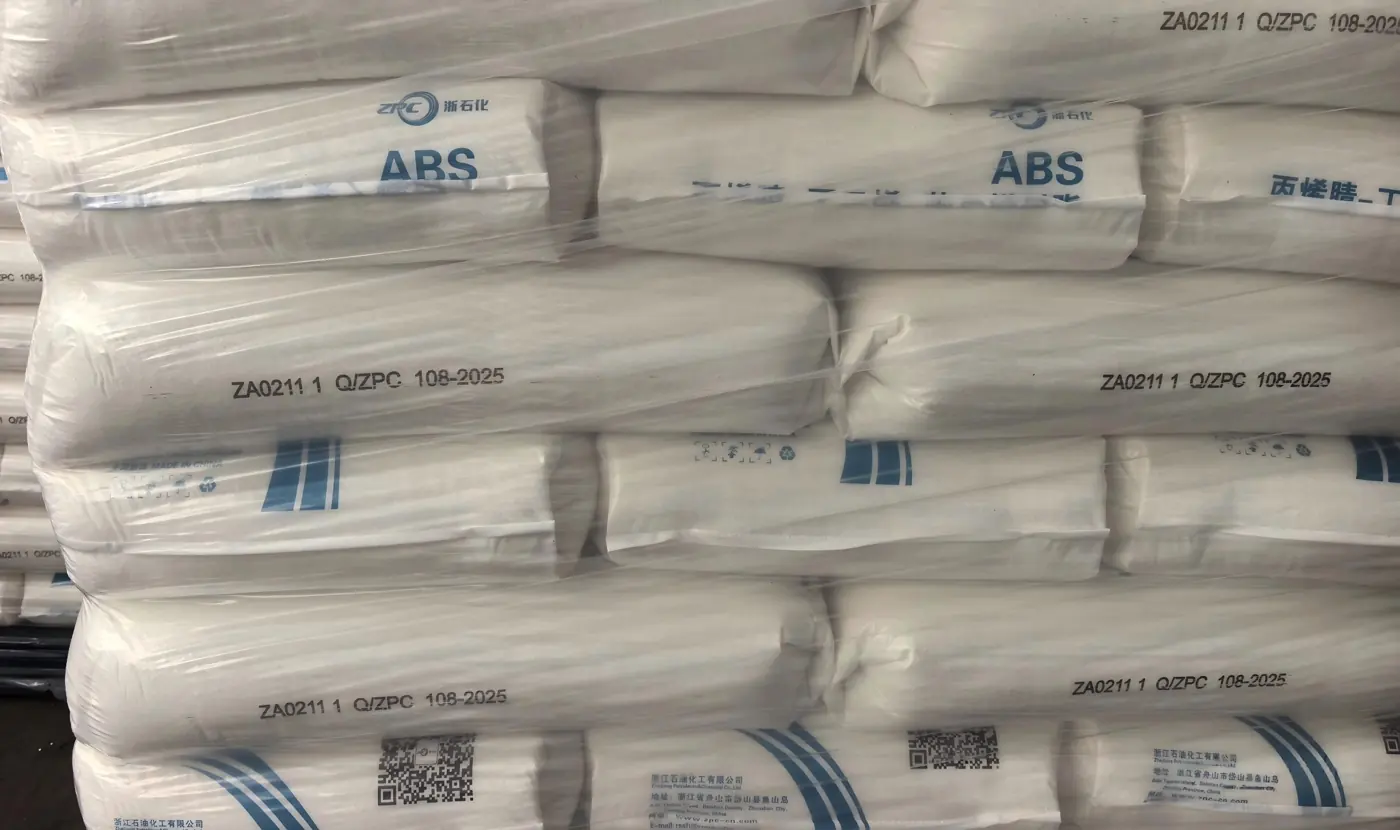
- Different standards. ZA0211 is made to Q/ZPC 108 and ZA0210 to Q/ZPC 100. The grade and standard are printed on every bag, so the two are easy to tell apart at goods-in.
- Not interchangeable without approval. A part approved on one grade should be ordered and received as that grade. Switching needs a trial, like any other material change.
Certificate data side by side
The table compares ZPC product qualification certificates for one recent lot of each grade. The specification limits are the same for both; the results are the measured values for that lot.
| Property | Specification limit | ZA0211 lot result | ZA0210 lot result | Test method |
|---|---|---|---|---|
| Melt mass-flow rate, 220 °C / 10 kg | 18.0–24.0 g/10 min | 20.3 | 21.0 | GB/T 3682.1 |
| Tensile strength | ≥ 40.0 MPa | 44.1 | 43.2 | GB/T 1040.2 |
| Flexural strength | Reported | 68.5 MPa | 68.4 MPa | GB/T 9341 |
| Flexural modulus | ≥ 2,300 MPa | 2,494 | 2,520 | GB/T 9341 |
| Charpy notched impact, 23 °C | ≥ 16.0 kJ/m² | 23 | 26 | GB/T 1043.1 |
| Vicat softening temperature, B50 | Reported | 94.3 °C | 95.4 °C | GB/T 1633 |
| Yellowness index | Reported | 3.9 | 4.2 | ASTM E313 |
| Whiteness | Reported | 44.8 | 43.0 | ASTM E313 |
| Large / small granules | ≤ 5 g/kg each | 0.1 / 0.1 | 0.2 / 0.1 | SH/T 1541.1 |
| Color granules | 0 per kg | 0 | 0 | SH/T 1541.1 |
| Enterprise standard | / | Q/ZPC 108-2024 | Q/ZPC 100-2024 | / |
Results are for single lots produced in 2025 and will vary from lot to lot within the specification limits. “Reported” means the property is measured and stated on the certificate without a limit.
Typical data-sheet values add three properties not shown on the certificates: a heat deflection temperature of 83 °C (1.8 MPa, unannealed) for both grades, mold shrinkage of 0.4–0.7%, and a UL 94 HB rating at 1.5 mm for ZA0211.
Where the two grades differ
- Documentation, not performance. The two grades share every specification limit, and their lot results differ by less than normal lot-to-lot variation. The meaningful difference is the enterprise standard each grade is made to, which is what drawings, approvals and COAs refer to.
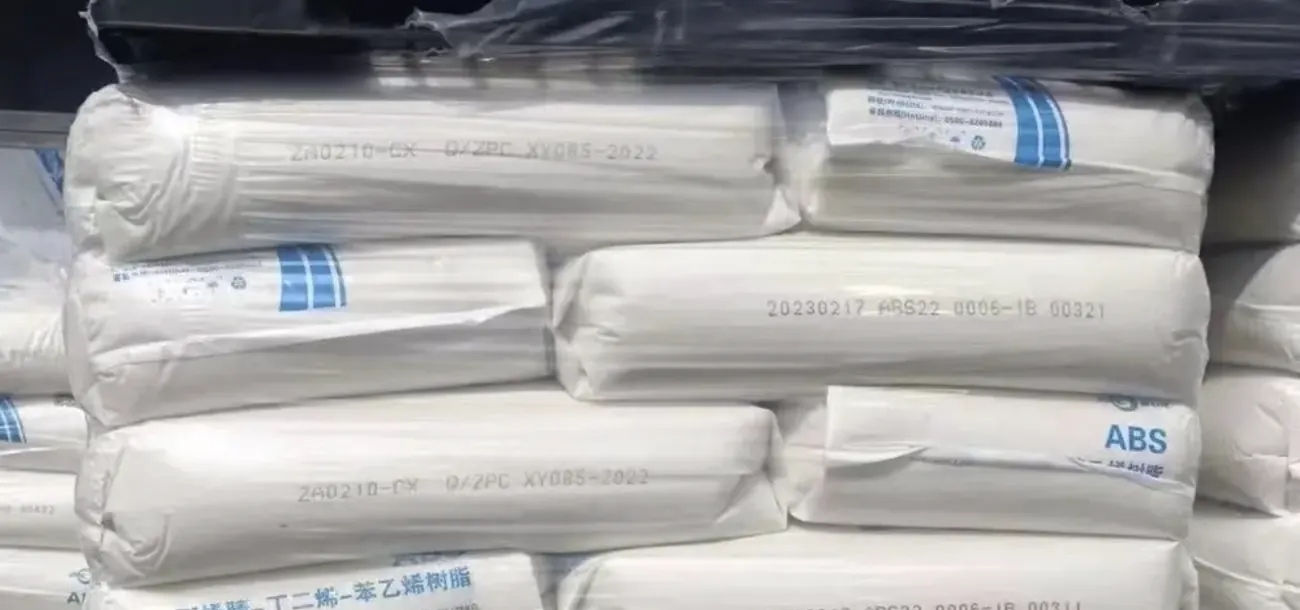
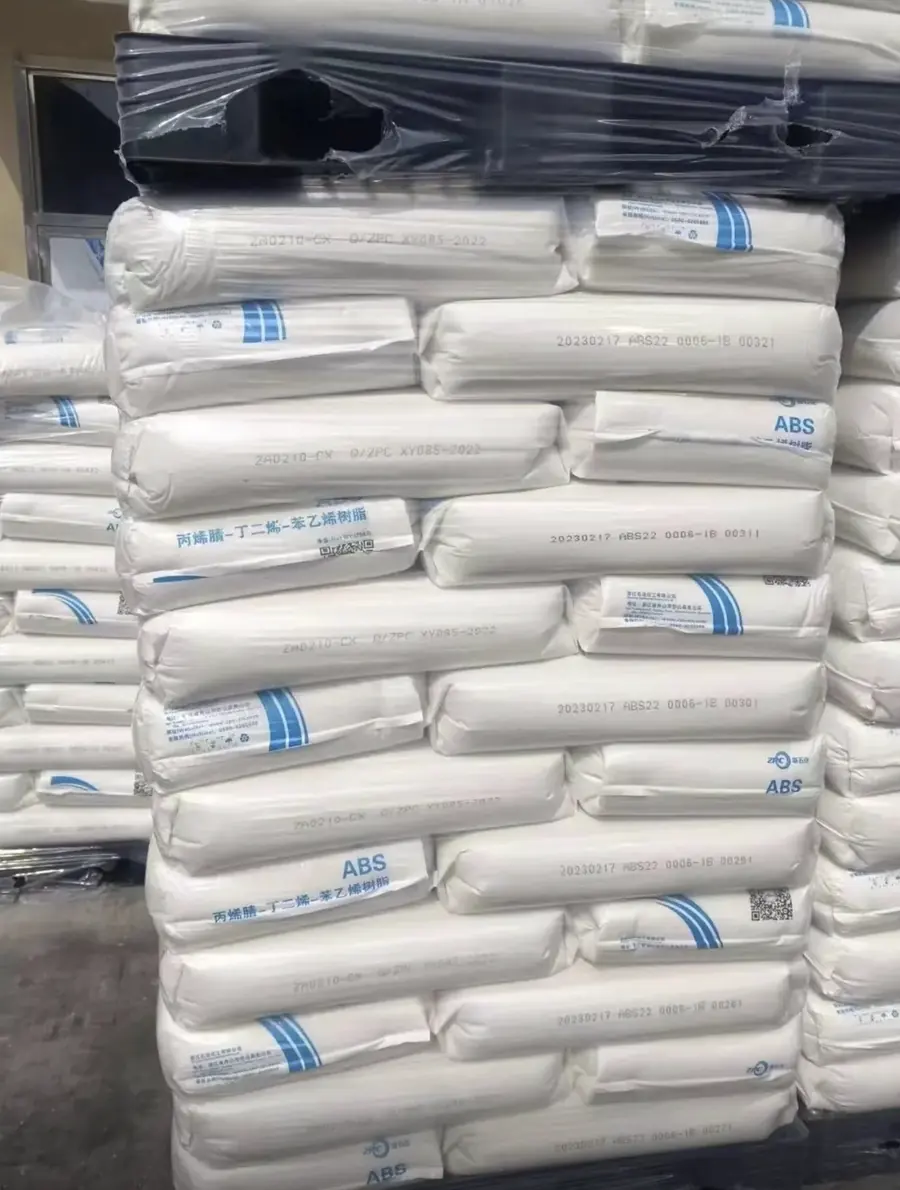
- Bag print. ZA0211 bags are printed “ZA0211 1” with the Q/ZPC 108 standard number. ZA0210 bags carry the ZA0210 designation and its own standard number. Older ZA0210 stock may show an earlier designation and standard, such as “ZA0210-CX Q/ZPC XY085-2022”; check the certificate that comes with the lot.
- Natural color. Both certificates report a low yellowness index (3.9 and 4.2), so both work as a base for white and light-colored parts. Run a color trial whenever the grade changes.
How they compare with imported general-purpose ABS
Both ZPC grades are often evaluated as alternatives to imported general-purpose ABS. The table places them beside the grades most often compared in sourcing.
| Grade | Flow, 220 °C / 10 kg | Notched Charpy, 23 °C | Vicat B (50 N) | Basis |
|---|---|---|---|---|
| ZPC ZA0211 | MFR 20.3 g/10 min | 23 kJ/m² | 94.3 °C | Lot result, GB/T |
| ZPC ZA0210 | MFR 21.0 g/10 min | 26 kJ/m² | 95.4 °C | Lot result, GB/T |
| INEOS Terluran GP-22 | MVR 19 cm³/10 min | 22 kJ/m² | 96 °C | Typical, ISO |
| CHIMEI PA-757 | MVR 18 cm³/10 min | 21 kJ/m² | 100 °C (5 kg) | Typical, ISO |
| PetroChina 0215A | MFR 22 g/10 min | 22 kJ/m² | 96 °C | Typical, GB/T |
GB/T and ISO methods differ in specimen preparation and conditioning, MFR and MVR are different measurements, and lot results, typical values and specification limits are not directly equivalent. The columns show direction, not exact equivalence.
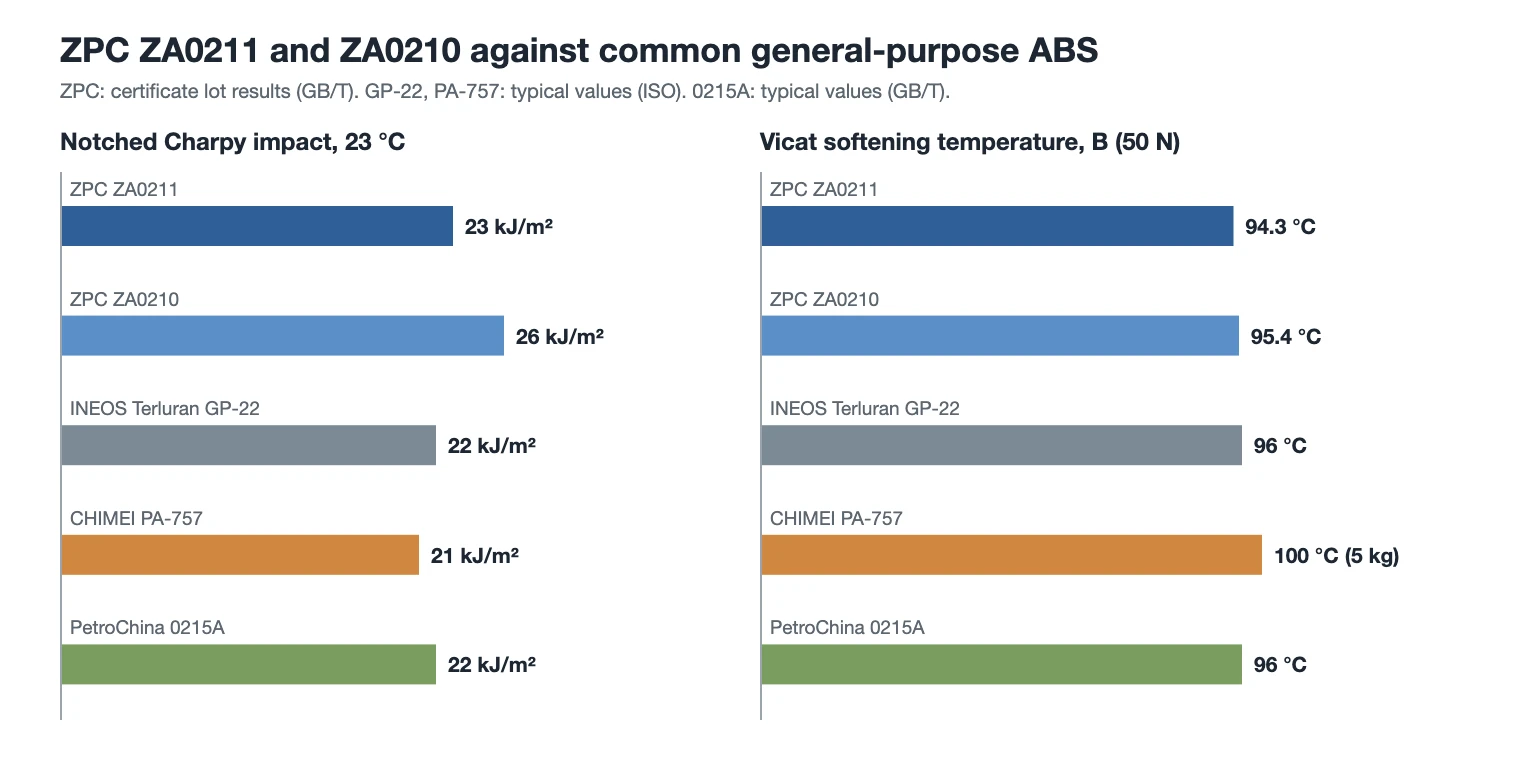
- Impact is on par or better. The ZPC lot results (23 and 26 kJ/m²) are at or above the typical values of GP-22 and PA-757, though under a different test standard. A drop or snap-fit test on the part is the reliable check.
- Heat resistance is close to GP-22. Vicat values of 94–95 °C are close to GP-22 and 0215A (96 °C) and about 5 °C below PA-757 (100 °C at 5 kg). For housings near motors or heating elements, test at the highest service temperature.
- Cold impact is not certified. Neither ZPC certificate reports impact below room temperature. For outdoor or cold-storage parts, request data or run a low-temperature drop test.
Applications
| Part family | Why ZA0211 or ZA0210 is used | What to test before approval |
|---|---|---|
| Small appliance housings (vacuum cleaners, hair dryers, air purifiers, rice-cooker covers) | Surface quality and impact balance at medium flow | Gloss and weld lines on the production tool, drop test, heat near the motor or heater |
| Appliance panels and covers | Stable shrinkage and low yellowness for light colors | Dimensions after conditioning, warpage, color match |
| Electrical housings (adapters, switch and socket frames, instrument cases) | Rigidity and dimensional stability | Screw-boss strength, snap-fit test; flammability requirement of the end product |
| Office equipment and general molded parts | Easy processing on standard machines | Fill on thin sections, cycle time, surface defects |
Neither grade is flame retardant. Where an electrical product standard requires UL 94 V-0 or V-2, use a flame-retardant compound with its own rating.
Processing window
Both grades run on standard injection-molding machines with the same settings. ABS absorbs moisture from the air, so drying is required.
| Parameter | Typical setting | Practical note |
|---|---|---|
| Drying | 75–85 °C, 2–4 h | Use a dehumidifying dryer. Undried material shows splay (silver streaks) and loses impact strength. |
| Barrel temperature | 180–220 °C | Start mid-range. Raise temperature for long flow paths rather than raising injection pressure. |
| Nozzle temperature | 200–220 °C | Avoid long residence at the upper end; it can cause yellowing in light colors. |
| Mold temperature | 40–70 °C | Use the upper end for high-gloss surfaces and less visible weld lines. |
| Back pressure | 10–30 bar | Higher back pressure improves masterbatch dispersion. |
| Mold shrinkage | 0.4–0.7% | The same range as most general-purpose ABS, so a change between the two ZPC grades, or from an imported grade, rarely needs tool changes. |
Qualifying ZA0211 or ZA0210
Whether the ZPC grade replaces an imported grade or one ZPC grade replaces the other, the change follows the same route. Where the drawing names Terluran GP-22 or another specific grade, see our guide to Terluran GP-22 alternatives for the approval route.
- Data review. Compare flow, notched impact, Vicat and HDT with the grade in use, keeping in mind the GB/T and ISO difference.
- Documentation. Collect the TDS, SDS and a recent certificate, plus the compliance statements the part requires, such as RoHS or REACH.
- Molding trial. Run the grade on the production tool. Record fill, cycle time, part weight, gloss and color.
- Part testing. Drop or impact test, heat test at the highest service temperature, and dimensions after conditioning.
- Approval and incoming control. Approve the grade by name and check MFR and impact on each lot’s certificate against the approved range.
Supply and incoming inspection
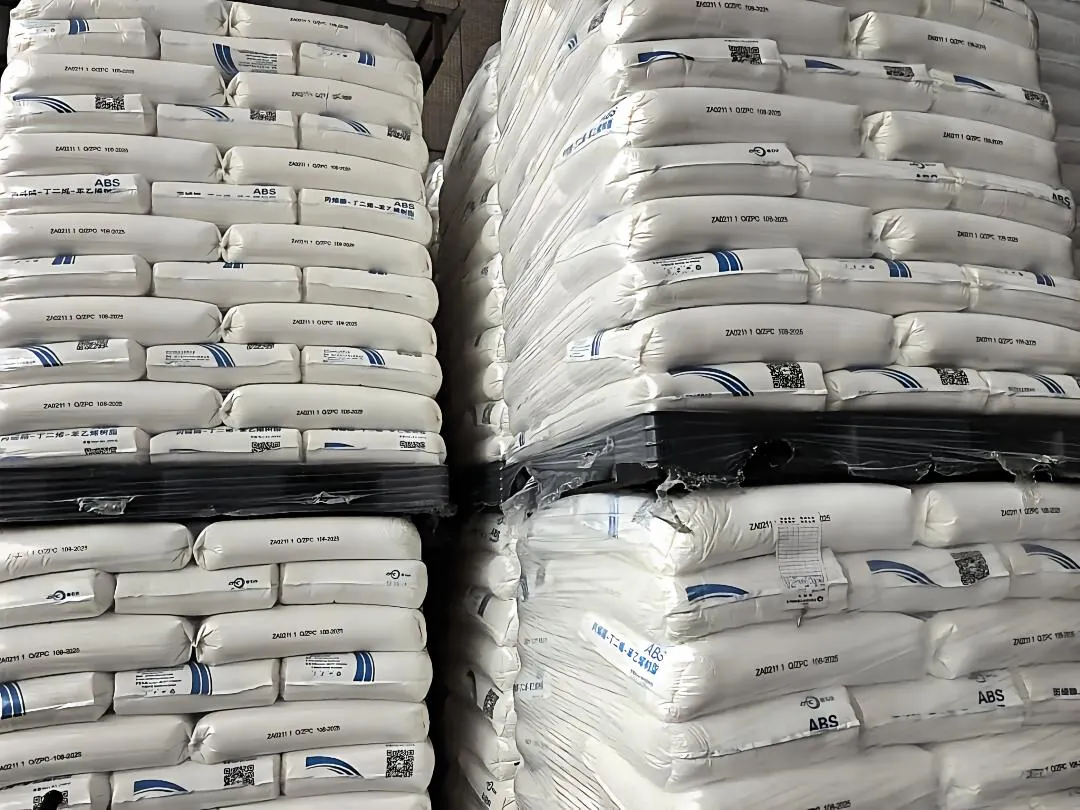
Both grades are supplied as natural pellets in 25 kg bags on pallets, each lot with a ZPC product qualification certificate. At goods-in, check that:
- The bag print shows the grade ordered, ZA0211 or ZA0210, with its enterprise standard.
- The batch number on the certificate matches the delivery.
- MFR and Charpy impact on the certificate sit within the range approved during qualification.
Keep bags sealed and stored indoors, and dry material from any opened bag before molding.
General-purpose ABS in our catalog
| Grade | Flow as published | Basis | Positioning |
|---|---|---|---|
| ZPC ZA0211 | 18.0–24.0 g/10 min (220 °C/10 kg) | Specification limits, GB/T | Appliance and electrical housings |
| ZPC ZA0210 | 18.0–24.0 g/10 min (220 °C/10 kg) | Specification limits, GB/T | Appliance and electrical housings |
| INEOS Terluran GP-22 | MVR 19 cm³/10 min | Typical, ISO | General-purpose injection, housings |
| CHIMEI PA-757 | MVR 18 cm³/10 min | Typical, ISO | High gloss, medium impact |
| PetroChina 0215A | 22 g/10 min | Typical, GB/T | Domestic general-purpose grade |
| Hengli HA-714 | 20.0–23.0 g/10 min | Specification limits, GB/T | Domestic general-purpose grade |
All grades are listed under ABS resin.
Frequently asked questions
What is the difference between ZA0211 and ZA0210?
Can ZA0210 replace ZA0211, or the other way round?
Who produces ZA0211 and ZA0210?
Can these grades replace Terluran GP-22 or CHIMEI PA-757?
Are ZA0211 and ZA0210 flame retardant?
Do they need drying?
Are they suitable for white and light-colored parts?
What comes with each delivery?
ZA0211 and ZA0210 give appliance and electrical molders two domestic general-purpose ABS grades with certified properties close to the common imported grades. The choice between them is mostly a matter of which grade a part was approved on. Purchasing teams that name the grade exactly and check each lot’s certificate can use either with confidence.